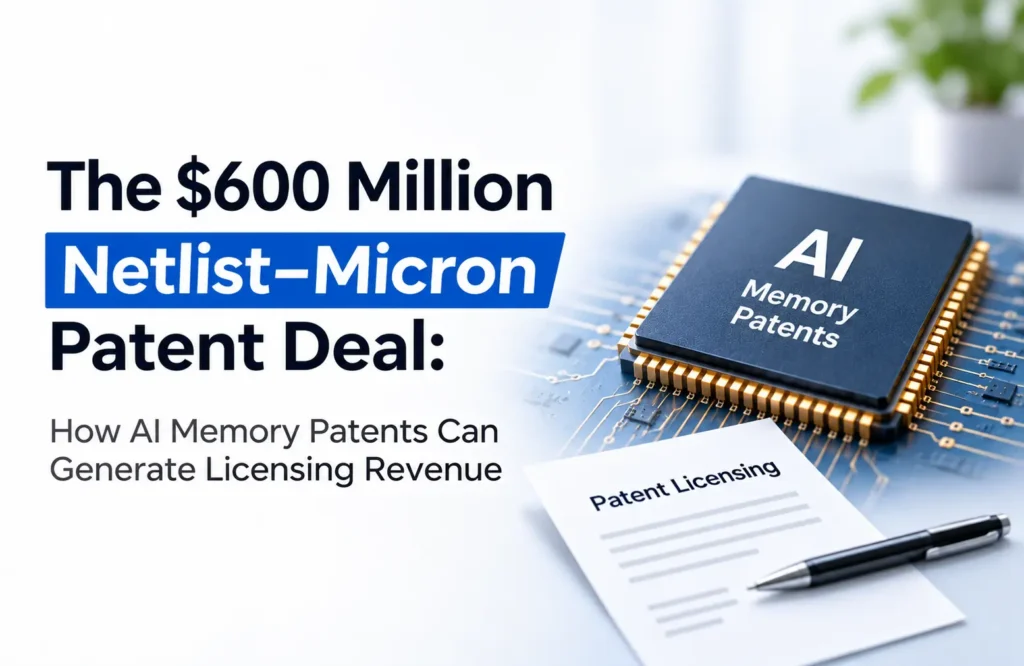
In October 2026, Netlist and Micron signed patent license and settlement agreements. Micron received a five-year license to Netlist’s worldwide patent portfolio including patents covering server DIMMs and high-bandwidth memory. Netlist will receive $30 million each quarter for 20 quarters which comes to $600 million in license payments.
The commercial significance of the transaction is the licensing structure: Netlist retains its patent portfolio while receiving scheduled payments for the rights granted to Micron.
So what makes a patent portfolio relevant enough to support a deal like this? This blog looks at how the deal is structured, why AI memory matters, how patents are assessed, who the potential licensees are and what other owners can learn.
What the $600 Million Netlist-Micron Patent Deal Covers?
Micron will pay Netlist $30 million per quarter for 20 calendar quarters from the fourth quarter of 2026 through the third quarter of 2031. That adds up to $600 million over five years. This figure is the scheduled license payments under this agreement. It is not a valuation of Netlist’s whole patent portfolio.
In return, Micron received a five-year license to Netlist’s worldwide patent portfolio. According to the SEC filing, the license is worldwide, non-exclusive, non-transferable and non-sublicensable. So Micron gets defined rights to use the patents, not ownership of them.
The deal also included a settlement. Both companies agreed to release all pending legal proceedings between them. That makes it a license and a settlement together not a simple technology sale.
Also Read: Protecting the Design Is Only the Beginning: How Car Design Patents Support Commercial Strategy
The Role of AI Memory Patents in the Netlist–Micron Agreement
Netlist’s announcement points to patents covering server DIMMs and high bandwidth memory. These are part of the memory setup used in advanced computing and HBM matters most in systems that need to move a lot of data quickly. That is the link to AI. But the source does not say every Netlist patent is an AI patent, so it is safer not to claim that.
A patent tied to AI hardware is not automatically valuable. Its licensing potential depends on the claims, how the technology is built, where it is used, who might need it, its legal status, competing IP and market demand.
For R&D teams holding memory or semiconductor IP, the key question is simple: does this technology give another company a real reason to want access?
How Can Patent Licensing Generate Revenue Without Selling the Patent?
A patent license gives another company defined rights to use a patent under agreed terms. Those terms can cover how long the license lasts, where it applies, whether it is exclusive and what products are included.
They can also set limits on sublicensing and spell out payments. The Netlist–Micron deal is a good example. Micron got a five-year, worldwide, non-exclusive license that it cannot transfer or sublicense. That is different from an assignment where ownership moves to the buyer. With a license, Netlist keeps its patents and still controls how they are used. This matters for companies that want income from their IP without giving it up.
The payment structure also shows why licensing terms should be evaluated separately from patent valuation. The parties negotiated a defined payment schedule based on the rights and commercial circumstances of this agreement rather than applying a standard market rate to the patents.
What Makes a Patent Portfolio Suitable for a Licensing Opportunity?
A patent portfolio attracts licensees when its technology solves a real commercial need not just because it is large. Here are the factors that shape licensing potential.
1.) Patent Claims and Technical Scope
Start with the claims. Independent claims set the broadest protection, while dependent claims add narrower detail and can serve as fallback positions. Next, look at the technical limitations, since they decide how much the patent really covers.
Then check how the claims line up with real products and which applications they reach. A portfolio should not be judged by its patent count. A smaller portfolio with strong technical and commercial relevance may be more useful for licensing than a larger portfolio whose claims have limited connection to market applications.
2.) Ownership and Legal Status
Before approaching a licensee, make sure the basics are clean. Confirm who owns the patents today and check the assignment history for gaps. Separate granted patents from pending applications and verify that maintenance fees are paid. Remaining patent term matters too since a short runway limits what a licensee will pay for.
Finally, note any disputes or validity challenges. A licensee needs confidence that the rights on offer are properly controlled and can be used commercially, or the talks may stall early.
3.) Technology Readiness and Commercial Application
A strong patent still needs a clear path into the market. Ask whether the technology can realistically fit into products, systems, manufacturing processes or R&D programs. Think about future product roadmaps too, since licensees often plan years.
If a company can see where the technology would be used, the patent becomes a business decision not just a legal asset. If that path is unclear, licensing talks usually go nowhere.
4.) Competitive IP Environment
A patent does not exist in isolation. A patent landscape analysis shows related patents, competing technologies and the major patent holders in a field. It also reveals whether an area is crowded or whether the technology stands out. That context helps owners judge their position.
When a specific product or implementation is being reviewed, a freedom-to-operate analysis can flag possible infringement risks before they become costly.
How Should Patent Owners Identify Potential Licensees?
Start with the technology, not the industry label. For memory-related patents, that could mean companies working in semiconductors, server infrastructure, memory systems, data centers or advanced computing hardware.
Next, check whether the patent fits what the company actually needs. Does it address a gap in their product roadmap, R&D program, or current technology design? If it does, they are a much stronger target.
Then think about the deal itself. The right structure might be a non-exclusive license, an exclusive license, an assignment, a patent sale or a technology partnership. Each one suits different goals. The aim is to match your rights and business objectives with the structure that makes sense for both sides.
Commercialization Lessons for Patent Owners from the Netlist–Micron Deal
The broader lesson is that portfolio strategy should be driven by commercial application rather than patent volume. Owners need to determine which assets support a credible business use case and whether those assets should be licensed, retained for internal development, assigned or included in a broader transaction.
This assessment can also help owners prioritize their portfolios. Some assets may warrant active licensing discussions, while others may be better suited to internal development, retention, assignment or eventual sale.
The deal also shows that disputes and commercial talks can meet in one agreement. Netlist and Micron settled their cases and signed a license together. But litigation is not a requirement for licensing. The business goal should decide the strategy.
Does the $600 Million Deal Set a Benchmark for Patent Valuation?
Not really. The $600 million figure belongs to this one agreement. It reflects the payment structure the two companies negotiated, the five-year term, the rights Micron received and the business situation between them. It is not a valuation of every patent Netlist owns.
It also does not mean every AI or semiconductor patent can earn similar payments. Owning patents in a hot field guarantees nothing.
For owners considering a transaction, these factors should be assessed together rather than in isolation. The objective is to determine whether the IP presents a sufficiently clear commercial opportunity to justify further valuation, outreach, negotiation and due diligence.
How Patent Monetize Can Help Patent Owners Explore Commercialization Opportunities?
Once a patent owner understands the technology, the claims, and the likely counterparties, the next step is getting the IP in front of the right people. Patent Monetize offers a marketplace where owners can present patents to potential licensees, buyers, technology partners and other commercial counterparties.
It also helps from the buyer side. Companies often look outside their own R&D when they need technology that fills a gap, strengthens an existing portfolio, supports product development or brings in outside innovation. A marketplace gives them a place to find it.
For buyers, this creates another channel for discovering external IP that may complement existing R&D or technology portfolios. For owners, the platform provides an environment for presenting relevant assets and exploring whether potential counterparties may have a commercial interest.
Key Takeaways for Patent Owners
The Netlist–Micron deal offers a few practical lessons for anyone holding patents with commercial potential. Here are the main points to keep in mind.
- The Netlist–Micron deal is a five-year patent license, not a patent sale.
- Micron will pay $30 million a quarter for 20 quarters, a total of $600 million.
- The licensed portfolio includes patents covering server DIMMs and HBM technologies.
- Licensing can bring in structured revenue while the owner keeps the patents.
- Commercial potential depends on the claims, technical relevance, legal status, market use, and likely counterparties.
- Being tied to AI does not make a patent valuable on its own.
- Owners should weigh licensing against assignment, sale, and other ways to commercialize.
Final Thoughts
The Netlist–Micron transaction is useful because it connects patent rights with a specific commercial need. The agreement shows how the value of a patent portfolio can be realized through negotiated rights, rather than relying solely on internal use or an outright transfer of ownership.
For companies with underused technology, the practical next step is to assess where their strongest IP fits within the market and which potential counterparties may have a reason to access it. That assessment can help determine whether further commercialization discussions are justified.
If your company holds patents with commercial potential, Patent Monetize can help present them to buyers, licensees, and other counterparties. Explore Patent Monetize to find opportunities in patent licensing, acquisition and broader technology commercialization.
Recent Post
-
 The $600 Million Netlist–Micron Patent Deal: How AI Memory Patents Can Generate Licensing Revenue
-
 Protecting the Design Is Only the Beginning: How Car Design Patents Support Commercial Strategy
-
 Build or License? The IP Strategy Automotive Companies Should Consider Before Investing in New Technology
-
 Can Listing a Product Online Amount to Patent Infringement? Delhi High Court’s Ruxolitinib Decision Explained
-
 Europe Moves to Strengthen IP Valuation: Why Patent Valuation Is Becoming a Strategic Priority