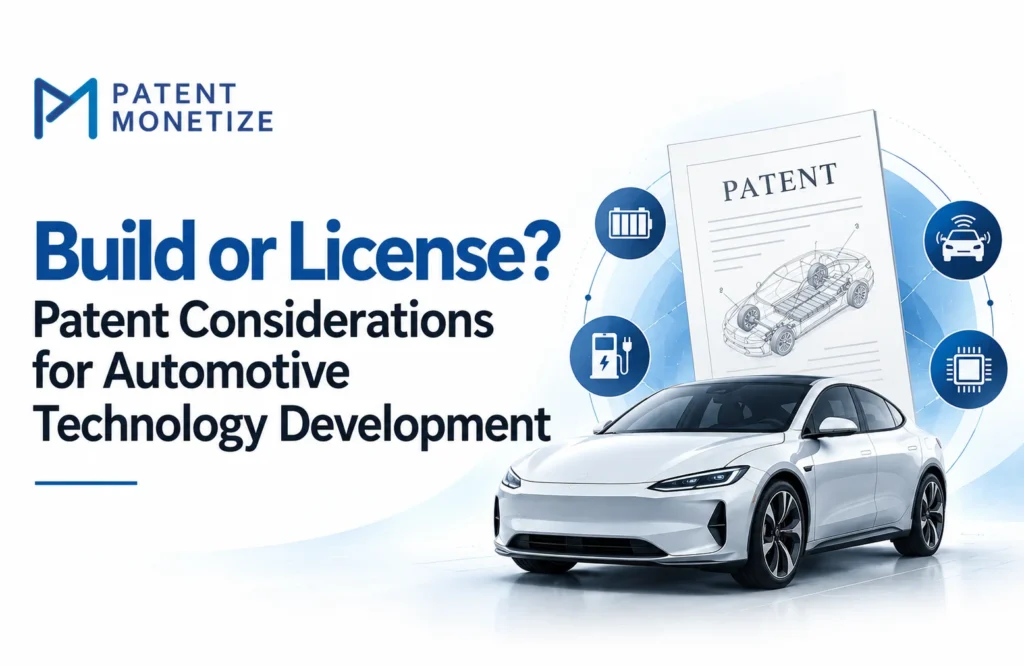
Automotive companies are working on technologies like battery management systems, vehicle safety features and EV charging solutions. These projects call for major R&D and commercialization investment, so it makes sense to review existing patent rights early, before development goes too far.
Developing a technology on your own does not remove the risk of infringement. Another company may already hold patent claims that cover a similar approach and the issue can surface after launch.
That raises a bigger question: should the company build the technology internally, license an existing one or acquire the technology or patent rights? The answer depends on technical, legal and commercial factors and each one deserves a careful look.
Understand the Existing Patent Landscape Before Developing Technology
Consider a company developing a novel battery cooling system for an electric vehicle. A preliminary patent review can show which patent families already cover similar cooling designs and who owns them.
A patent landscape analysis goes further. It maps patent owners, existing technical solutions, filing activity and geographic protection and it can point to possible technology partners or licensing opportunities.
Finding similar patents does not mean development must stop, because relevance depends on the patent claims not the title or abstract.
Geography matters too. A patent in one country may not apply in another market where the vehicle is made or sold. Still, a landscape gives strategic context only. It does not replace a freedom to operate assessment.
Building Technology Internally: Consider Freedom to Operate
Suppose an automotive company develops its own EV charging mechanism and secures a patent on the improvement. That patent protects the novel innovation, but it does not give the company unrestricted freedom to manufacture and sell the product. The improvement may still rely on features covered by earlier third-party patents.
Patentability tests whether an invention is novel and inventive. Freedom to operate (FTO) asks whether the product can be made and sold without infringing someone else’s claims.
An FTO assessment maps relevant patent claims against the technical features of the product or process in every target jurisdiction. If risks come up, the company can redesign the technology, get further legal advice, examine validity or enforceability or begin licensing discussions.
It is best to do this before committing to manufacturing, tooling and launch. Where risks are manageable, internal development can remain attractive, since it builds proprietary IP.
When Should Automotive Companies Consider Patent Licensing?
Consider a company that needs specialized battery thermal-management technology. Developing an alternative internally would require engineering, integration and validation work. In that case, a patented technology that already exists may be worth a closer look.
A patent licensing agreement grants defined rights to use protected technology. It can also provide a ready technical solution, saving the company from developing the entire approach itself. But holding a patent does not mean the technology is ready for production. Before going ahead, the company should check who owns the patent, how far the claims extend, where protection applies and whether the license is exclusive or non-exclusive.
Field-of-use limits, upfront payments, royalties and milestones also need attention. So do technical documentation, prototypes, validation data and implementation support.
Some companies take a hybrid path, developing the core technology in-house while licensing one component or process. The best option comes down to technical requirements, commercial flexibility and long-term strategy.
What If You Own an Automotive Patent but Have Not Commercialized It?
Now consider the other side. Inventors and R&D teams may hold patents in battery cooling, EV charging, vehicle safety, or electronic controls, yet still lack the manufacturing capacity, funding, or commercial network to bring them to market.
Patent licensing offers one route, since the owner does not have to manufacture the final product. The harder task is finding the right licensee, which takes more than targeting companies in the same industry. It requires a review of the patent claims, technical applications, geographic protection, development evidence and commercial relevance.
Platforms such as Patent Monetize connect patents with companies whose products, R&D work, manufacturing strengths and technology requirements fit.
Depending on the case, the structure may be exclusive licensing, non-exclusive licensing, patent assignment or technology transfer. The goal is to reach organizations with a credible commercial reason to evaluate the technology.
Also Read: Europe Moves to Strengthen IP Valuation: Why Patent Valuation Is Becoming a Strategic Priority
How Patent Monetize Supports Automotive Patent Commercialization?
Once a patent’s technical and commercial relevance has been assessed, reaching suitable counterparties becomes an important part of the commercialization process. Patent Monetize provides a platform focused on patent and technology commercialization.
Patent holders can present eligible patent assets and explore commercial interest from relevant companies. Support includes patent assessment, technology presentation, identification of potential licensees or buyers, targeted commercial outreach and help with transactions and due diligence.
Outcomes still depend on the patent rights, technical applicability, market requirements, counterparty interest and the terms negotiated between the parties. The platform helps structure that process and reach the right audience, but it does not promise a license, a sale or a particular valuation.
Making the Right Technology Investment Decision
Cost of development is just one factor in the decision. The appropriate route depends on the company’s technical requirements, desired level of control, IP objectives and commercial strategy.
Acquisition may bring ownership of strategically relevant patent rights. The decision should reflect the company’s immediate technology requirements as well as its broader IP and commercial strategy.
Patent holders weighing commercialization opportunities need the same analysis, since it shows what rights they can offer and where those rights have value. An effective IP strategy links technology development with legally supportable rights and commercially relevant opportunities.
The Bottom Line
For patent holders evaluating commercialization options, Patent Monetize provides a way to present their technology and explore potential interest from relevant companies. If you own a patented technology in areas such as battery systems, EV charging, vehicle safety or electronic controls, you can list it on the platform and see whether relevant companies show interest.
Automotive companies looking for existing technology can also review available patent assets as they decide whether to build, license or acquire.
The right commercialization route will depend on how well the technology fits the relevant market and the objectives of the parties involved. A clear commercialization strategy is a good place to start.
To begin, list your patent on Patent Monetize or contact our team to discuss your options.
Recent Post
-
 Build or License? The IP Strategy Automotive Companies Should Consider Before Investing in New Technology
-
 Can Listing a Product Online Amount to Patent Infringement? Delhi High Court’s Ruxolitinib Decision Explained
-
 Europe Moves to Strengthen IP Valuation: Why Patent Valuation Is Becoming a Strategic Priority
-
 188 Patents, One Licensing Strategy: How Patent Portfolios Are Being Built for Commercialization?
-
 AWS’s $1 Billion + IP Licensing Deal: Why Companies License Technology Instead of Building Everything In-House