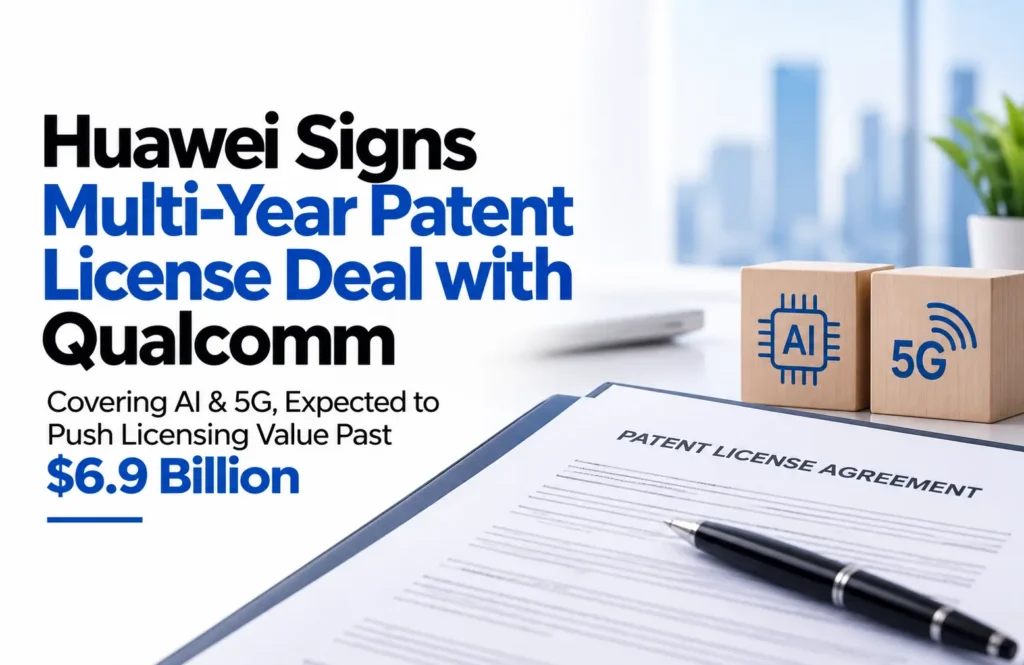
Huawei has signed a multi-year patent licensing deal with Qualcomm. It covers a wide range of technology, including AI, 5G, computing and networking. Under the deal, each company can use the other’s patented technology under agreed terms, while Qualcomm will also purchase certain Huawei U.S. patents.
The financial details have not been shared. Huawei expects the deal to help push the total value of its patent licensing agreements above $6.9 billion.
That makes this more than a simple tech partnership. It shows how a large patent portfolio can turn into a real business asset. Years of research can become a steady source of income and even rivals can still work side by side.
Inside the Patent Deal
The deal covers several areas of technology: artificial intelligence, 5G, computing and networking. That is a wide range and it is not tied to one product or one invention. The companies have not said which patents are included or which products will use them, so it is best not to guess.
What we do know is that the agreement runs for multiple years. That matters because a one-time sale gives a company money once and ends there. A long-term license works differently.
It lets patent owners earn from their work over time while the other side gets access to the technology it needs under agreed terms. For both companies, that offers more stability.
How the Huawei-Qualcomm Patent License Works?
Patent licensing is simple at its core. A company that owns a patent lets another company use it under agreed terms. For the owner that turns an idea into income. Cross-licensing works both ways. Each side gets rights to use some of the other’s patents.
Under the agreement, each company can use the other’s patented technologies in the covered areas. For companies with large patent portfolios, that can mean access to needed technology while their own patents continue to generate value. It is not a magic fix, though. It does not guarantee success and it does not automatically prevent disputes.
The $6.9 Billion Question: What Does It Actually Mean?
It’s easy to think Qualcomm is paying Huawei $6.9 billion, but the figure measures the total value of Huawei’s patent licensing agreements.
The $6.9 billion represents the cumulative value of Huawei’s patent licensing agreements, and Huawei expects the total to pass that mark with this agreement included.
One deal is a single sale between two companies. A cumulative figure combines the value of multiple licensing agreements over time, so it should not be treated as the value of this individual transaction or as the value of Huawei’s entire patent portfolio.
So when you see a big figure, ask what it counts before you decide what a patent portfolio is worth.
What This Deal Reveals About Monetization
The Huawei-Qualcomm agreement illustrates how licensing can become part of a broader patent commercialization strategy. Companies with substantial patent portfolios can assess where their rights may support licensing or cross-licensing opportunities.
Portfolios can also support cross-licensing, sales or acquisitions. Here, Huawei and Qualcomm agreed to share access to patented technology in areas like AI and 5G, while Qualcomm will also purchase certain Huawei U.S. Patents. Each side gets access and each can earn value from its own IP.
For Patent Monetize readers, the lesson is clear: a patent is not just a legal right. It can be a valuable business asset.
Why AI and 5G Matter
The agreement covers AI and 5G, along with computing and networking. That mix is worth noticing. Today’s devices and networks often rely on several fields working together, so one product can touch many areas of technology at once.
That makes patent portfolios useful in more than one place. The broad technology coverage also shows how patent portfolios can support licensing and cross-licensing strategies across multiple connected technology areas. What we can say is that the deal reaches across these connected areas, not just one.
Lessons From the Huawei-Qualcomm Licensing Deal
Patents can do more than protect an idea. For some companies, they may also open the door to licensing. That is why it helps to build a portfolio with a plan. Before looking for licensees, know what you own. Check what the patents cover, who holds them, where they apply, their legal status and how useful the technology is.
Licensing can also let a company earn from its technology without giving up ownership of the patents. Still, not every portfolio will attract licensees or bring in large revenue. Careful planning simply gives a company a better chance of making smart choices.
The Monetization Takeaway
The Huawei-Qualcomm agreement also highlights the importance of viewing a patent portfolio as a whole rather than judging its potential by one patent or one transaction. Licensing, cross-licensing and patent sales can serve different commercial objectives depending on what the portfolio covers and how the owner wants to use its rights.
The $6.9 billion figure also shows why licensing activity should be viewed at the portfolio level. A single patent or transaction cannot, by itself, establish the value of an entire portfolio. The commercial potential of an IP portfolio depends on the rights it contains, its technical relevance and the licensing opportunities available to the owner.
The Huawei-Qualcomm agreement shows how patent licensing can connect intellectual property with commercial strategy. The financial terms of this specific deal have not been disclosed but Huawei expects the cumulative value of its patent licensing deals to exceed $6.9 billion once the transaction is completed.
The broader lesson for companies with large technology portfolios is to look beyond patent ownership and consider how licensing, cross-licensing, and other commercialization strategies can create opportunities for their IP.
Also Read:- Hassle-Free Closures: How Patent Monetize Manages Everything from Listing to Legal Closure
Recent Post
-
 188 Patents, One Licensing Strategy: How Patent Portfolios Are Being Built for Commercialization?
-
 AWS’s $1 Billion + IP Licensing Deal: Why Companies License Technology Instead of Building Everything In-House
-
 Huawei Signs Multi-Year Patent License Deal with Qualcomm Covering AI & 5G, Expected to Push Licensing Value Past $6.9 Billion
-
 Hassle-Free Closures: How Patent Monetize Manages Everything from Listing to Legal Closure
-
 Types of Patent Licensing: Exclusive, Non-Exclusive, and Sole Licenses Explained