Securing a patent grant is a critical milestone for any inventor, startup, or enterprise. It offers legal validation for your intellectual property (IP). However, statutory protection does not automatically translate into commercial revenue. Commercializing a patent requires substantial capital, manufacturing capabilities, and distribution infrastructure. Many patentees lack these operational assets.
This is where patent licensing becomes essential. Instead of bearing the financial risk of production, you can execute a licensing agreement. This contract grants a third party the right to make, use, or sell your patented technology in exchange for upfront fees or ongoing royalties. It allows you to generate revenue while retaining underlying ownership. But before you enter contract negotiations, you must understand the legal frameworks available. Selecting an unsuitable license type can restrict your market access or bind you to an underperforming licensee.
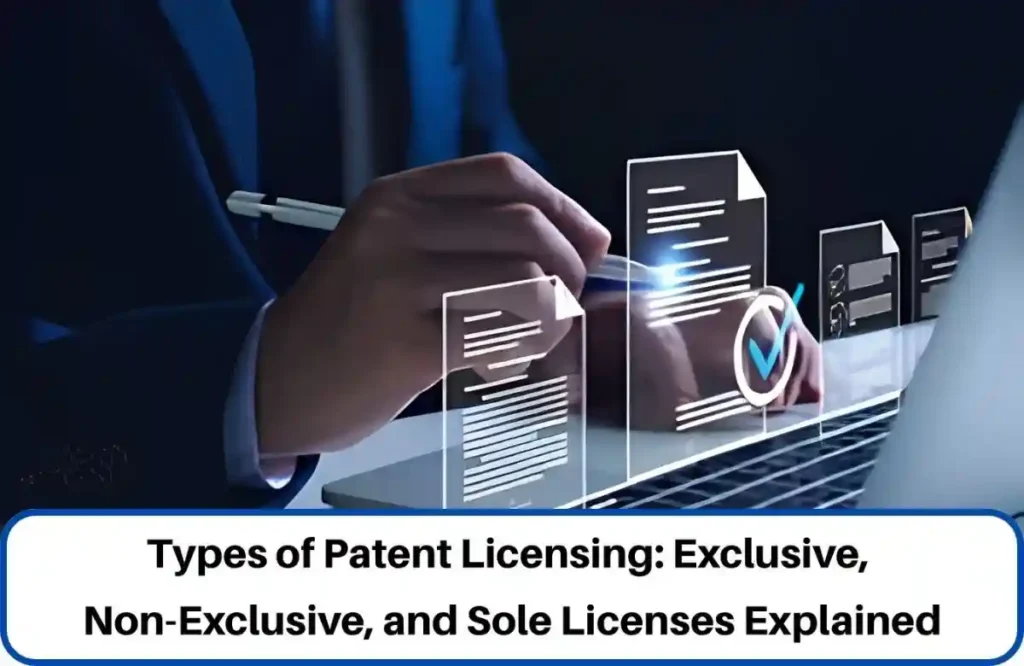
Let’s examine the three primary mechanisms of patent licensing, exclusive, non-exclusive, and sole licenses, so you can align your IP strategy with your commercial objectives.
Exclusive Licenses: Maximizing Capital through Transferred Rights
Under an exclusive license, the patent owner (the licensor) transfers all commercialization rights to a single partner (the licensee). This exclusivity applies to a defined territory, field of use, or duration. Once executed, no other entity can legally exploit the technology. In fact, even the licensor is barred from practicing the patent commercially unless explicit carve-outs are made.
Because the licensee assumes the entire commercial risk, they typically pay a premium. This structure yields substantial upfront fees, guaranteed minimum royalties, or milestone payments.
Application: This model suits capital-intensive industries like biotechnology or hardware development. Partners in these fields invest millions to scale production. They require absolute market exclusivity to prevent competitors from undercutting their market share.
The Risk: You depend entirely on one licensee’s performance. If they fail to market the technology effectively, your asset remains unexploited and locked away from the broader market.
Non-Exclusive Licenses: Driving Revenue through Broad Market Penetration
A non-exclusive license offers a broader operational approach. This framework allows the licensor to grant usage rights to multiple independent licensees simultaneously. Crucially, the patent owner also retains the right to exploit the technology for their own commercial operations.
Instead of relying on a single, large payout, this strategy focuses on market volume. You can issue licenses to numerous companies across distinct sectors. This creates multiple, concurrent revenue streams.
- Application: This is the standard mechanism for foundational software, hardware components, or industry standards like Wi-Fi protocols. The objective is widespread adoption. By keeping individual licensing fees reasonable, you incentivize the market to license your technology rather than engineering non-infringing workarounds.
- The Advantage: It mitigates risk. If one licensee underperforms or files for bankruptcy, your aggregate royalty stream remains stable because other licensees continue to generate revenue
Sole Licenses: The Hybrid Framework for Strategic Expansion
A sole license serves as a hybrid model. In this agreement, the licensor commits to granting commercial rights to only one external partner. No other third-party companies will receive a license.
But there is a distinct legal variance: the patent owner explicitly reserves the right to continue manufacturing, using, and selling the patented technology alongside the licensee.
- Application: This serves as an effective tool for expanding enterprises that possess a strong regional presence but lack the resources for global deployment.
- The Advantage: Suppose your entity is actively managing patent licensing in India and successfully supplying the domestic market, but you lack the infrastructure to enter European or North American jurisdictions. By executing a sole license, you can contract with a multinational corporation for those foreign territories while preserving your domestic commercial operations intact.
Deploying Your Asset via a Global Patent Licensing Platform
Understanding these legal frameworks is the first step. However, identifying qualified international counterparties and structuring compliant agreements presents a steep operational hurdle. For many patent holders, managing global IP transactions independently is inefficient.
Platforms like Patent Monetize streamline this process. Operating as a global digital marketplace and consulting platform, Patent Monetize acts as a mediator to connect patent owners with international buyers, licensees, and investors.
Instead of allowing valuable intellectual property to sit idle, utilizing a dedicated patent licensing platform enables innovators to list their portfolios, obtain market valuations, manage cross-border compliance, and execute precise licensing agreements. Ultimately, a patent’s value depends on its commercial execution. Choosing the correct licensing structure ensures your innovation achieves optimal market traction.
Read More: How Patent Monetize Connects Sellers and Pre-Vetted Corporate Buyers
Recent Post
-
 188 Patents, One Licensing Strategy: How Patent Portfolios Are Being Built for Commercialization?
 -
 AWS’s $1 Billion + IP Licensing Deal: Why Companies License Technology Instead of Building Everything In-House
 -
 Huawei Signs Multi-Year Patent License Deal with Qualcomm Covering AI & 5G, Expected to Push Licensing Value Past $6.9 Billion
 -
 Hassle-Free Closures: How Patent Monetize Manages Everything from Listing to Legal Closure
 -
 Types of Patent Licensing: Exclusive, Non-Exclusive, and Sole Licenses Explained