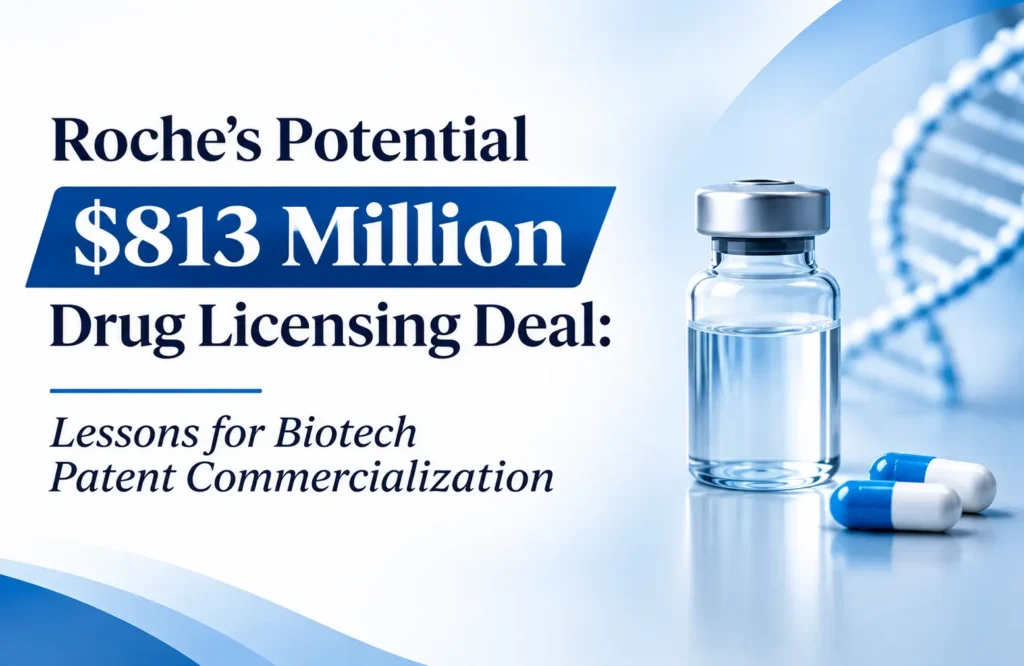
Patent Commercialization – On October 23, 2026, Zymeworks announced an exclusive global license and collaboration agreement with Roche for ZW209, a trispecific T-cell engager targeting DLL3. The deal could be worth up to $813 million but that money is not paid upfront or guaranteed.
Zymeworks is set to receive $55 million upfront, subject to closing conditions, and another $40 million once the Phase 1b trial begins. Up to $718 million more depends on milestones, plus royalties from high single digits to the mid-teens on future sales.
The deal also shows how a biotech company can use a licensing agreement to bring its technology to a larger commercial partner while retaining an interest in its underlying IP. This article looks at how the deal is built.
Understanding the Roche-Zymeworks $813 Million Licensing Deal
Zymeworks is a biotechnology company that develops multifunctional biotherapeutics. Roche is a large pharmaceutical company with global strength in research, development, manufacturing and sales.
Together, they make a practical pairing. Zymeworks brings its technology and early-stage development work while Roche brings the size and experience needed to take a drug to market.
Under the deal, Roche receives exclusive global rights to develop and commercialize ZW209, an experimental cancer therapy. It is a trispecific T-cell engager designed to target DLL3. Roche is not buying Zymeworks. This is a license and collaboration agreement not a sale. That difference matters for patent owners. Licensing gives another company the right to use and commercialize an asset while ownership can stay with the original owner.
Why Is the Deal Worth “Up to $813 Million”?
The “up to $813 million” figure is the total Zymeworks could earn if everything goes well. It is not paid on signing day. The first piece is $55 million upfront, which is the closest to immediate payment, though it still depends on conditions such as HSR clearance.
Another $40 million comes when the Phase 1b trial begins. The largest part, up to $718 million, depends on research, development, commercial and sales milestones that may or may not happen. On top of that, Zymeworks can earn royalties from the high single digits to the mid-teens on future net sales of approved products. So the $813 million shows potential payments under the deal not guaranteed revenue.
What Is ZW209 and Why Does Its Technology Matter?
ZW209 is a trispecific T-cell engager. In simple terms, it is built to connect with three targets: DLL3, CD3 and CD28. DLL3 is linked to certain tumor cells, especially in small-cell lung cancer. CD3 and CD28 are found on T cells. The innovation is to bring T cells close to cancer cells while giving them extra stimulation.
Zymeworks says the drug uses its TriTCE Co-Stim, Azymetric and EFFECT platforms, including a design meant to control CD28 engagement and T-cell activation.
The commercial question is bigger than whether the science is interesting. A major partner also looks at whether the technology is different, protectable and useful in the market. Still, the deal does not prove the drug works. It was signed early and Roche signed on before any efficacy data was available.
How the Roche-Zymeworks Agreement Is Structured?
Under the agreement, Zymeworks keeps ownership of important intellectual property. This includes specified know-how and patents tied to ZW209’s composition of matter, its T-cell engager platform, its multispecific antibody engineering and improvements to the Zymeworks Platform. The arrangement separates ownership of the underlying IP from Roche’s rights to develop and commercialize ZW209.
Roche gets the commercial rights. It receives exclusive global rights to develop, commercialize ZW209 and it will take over later global development and sales. Roche will also fund the Phase 1a trial that Zymeworks is running.
The agreement also allocates different responsibilities between the two companies with Roche taking on a larger role in later development and commercialization. It can also bring payments as the program moves forward, while royalties keep an economic interest in place. The company continues to benefit from its underlying IP, too. Still, this is one commercialization path not the best choice for every company.
Why Would a Biotech Company License Its Technology Instead of Selling It?
In a patent sale or assignment, ownership moves to the buyer. In a patent license, the owner keeps ownership while another party receives defined rights to use the technology.
For many biotech companies, licensing makes sense. They often have promising science, valuable patents and early drug candidates but limited money for global clinical trials, little manufacturing capacity and a small commercial reach. Large pharmaceutical companies tend to have the opposite strengths. They have bigger development teams, global regulatory experience, manufacturing capabilities, sales networks and the funds for later-stage development.
The Roche-Zymeworks agreement illustrates this model in practice: Zymeworks contributes the technology and existing development work while Roche takes on a broader role in advancing and commercializing the program.
What Makes Biotech Patents Attractive to Potential Licensees?
Licensees look first at patent strength. They check the scope of the claims, whether there is composition-of-matter protection, method-of-use claims, platform coverage, remaining patent term and a clean ownership and assignment history. In this deal, Zymeworks states that relevant patents extend into the 2040s, which could give a longer commercial runway if products reach the market.
Next comes how different the technology is. A partner will ask whether it solves a real problem, whether it is hard to copy and whether it works beyond one product.
Finally, a legally strong patent may still have little value without a real product or market. The ZW209 deal shows the full chain: patent, technology, drug candidate, development opportunity, market and commercial rights.
How Biotech Companies Earn From IP Through Milestones and Royalties?
A licensing deal can pay in several ways. First comes the upfront payment, which is paid when the agreement closes and depends on the contract’s conditions. Next are development milestones, which depend on steps such as starting a clinical trial, meeting development targets or passing regulatory stages. Here, Zymeworks can receive $40 million when the Phase 1b trial gets underway.
Commercial and sales milestones follow later and depend on how well the product does in the market. Royalties usually come from future sales. For ZW209, Zymeworks is eligible for tiered royalties ranging from the high single digits to the mid-teens on net sales.
For biotech companies, this kind of structure ties payments to the technology’s development and commercial progress.
Patent Valuation in Practice: Insights From the Roche Deal
The $813 million figure is not the value of Zymeworks’ patent portfolio. It is the most Zymeworks could receive under the licensing arrangement, including milestone payments that may never be triggered.
A patent’s value depends on much more than how many patents exist. Buyers and licensees look at claim strength and scope, remaining patent life, how different the technology is, the development stage, market size, regulatory path, competing technologies and the licensing terms. They also consider who the likely licensees are and how the technology could be used.
Context matters too. The commercial terms therefore reflect the specific technology, development opportunity, counterparty and negotiating circumstances involved in this transaction. This one reflects a specific technology, partner and set of negotiated terms.
The Risks Behind the $813 Million Headline
A large headline number can hide the uncertainty behind it, so here are the main risks to keep in mind.
- ZW209 is still in the early stages of clinical development, so how it will perform in trials is far from certain.
- Any drug candidate has to clear regulatory requirements before it can be sold and approval is never a given.
- Even if the medicine is approved, sales may fall short of what was expected.
- The scope, validity, enforceability and remaining term of the patents can all shape how well the product is protected.
- The full $813 million depends on future milestones being met, so it should not be counted as guaranteed income.
- The deal was subject to the Hart-Scott-Rodino waiting period ending along with other customary closing conditions.
Key Lessons for Biotech Companies Commercializing Their Patents
Start by identifying the commercial problem the IP can solve and the products or technologies where it could be used. Next, know exactly what you own. Before approaching licensees, check ownership, claim scope, patent status, expiration dates, related know-how, existing licenses, territorial rights, encumbrances and competing IP.
Then find the right counterparties. A good licensee has a real reason to want the technology, such as a related therapeutic pipeline, complementary technology, clinical-development skills, manufacturing capacity or commercial expertise.
The right structure should also reflect the owner’s objectives, including how much development responsibility it wants to retain and how it wants to participate in future commercial returns. Finally, owners should consider whether the transaction should preserve some economic participation as the technology moves through development and commercialization.
Also Read: The $600 Million Netlist–Micron Patent Deal: How AI Memory Patents Can Generate Licensing Revenue
How Patent Monetize Can Help Companies Explore Biotech IP Commercialization?
Once a company identifies IP with commercial potential, the next challenge is finding counterparties that may have a reason to license, acquire or partner around that technology. The Roche-Zymeworks deal shows why that matters, since the right counterparty can bring the resources to move a technology forward.
A marketplace can help owners present their IP to potential buyers, licensees and technology partners.
Patent Monetize is a platform for exploring patent licensing, acquisition, sales and wider commercialization opportunities. It does not promise a set valuation, buyer or revenue result but it gives owners a place to get started.
If your company holds biotech or pharmaceutical patents with commercial potential, explore Patent Monetize to present your IP to possible licensing, acquisition and commercialization counterparties.
Final Thoughts
The Roche-Zymeworks agreement illustrates how biotech IP can move from research and development into a structured commercial relationship without requiring an outright sale of the underlying technology.
For biotech companies, the broader lesson is to evaluate whether their IP has a clear commercial application, a defensible position and potential counterparties before pursuing a licensing strategy.
The key question for patent holders is therefore not only what they own but also where that IP fits in the market and which commercial structure can support its development.
Recent Post
-
 Roche’s Potential $813 Million Drug Licensing Deal: Lessons for Biotech Patent Commercialization
-
 Looking to Buy or Sell Fintech Patents? What Financial Technology and Insurance IP Owners Should Know
-
 The $600 Million Netlist–Micron Patent Deal: How AI Memory Patents Can Generate Licensing Revenue
-
 Protecting the Design Is Only the Beginning: How Car Design Patents Support Commercial Strategy
-
 Build or License? The IP Strategy Automotive Companies Should Consider Before Investing in New Technology