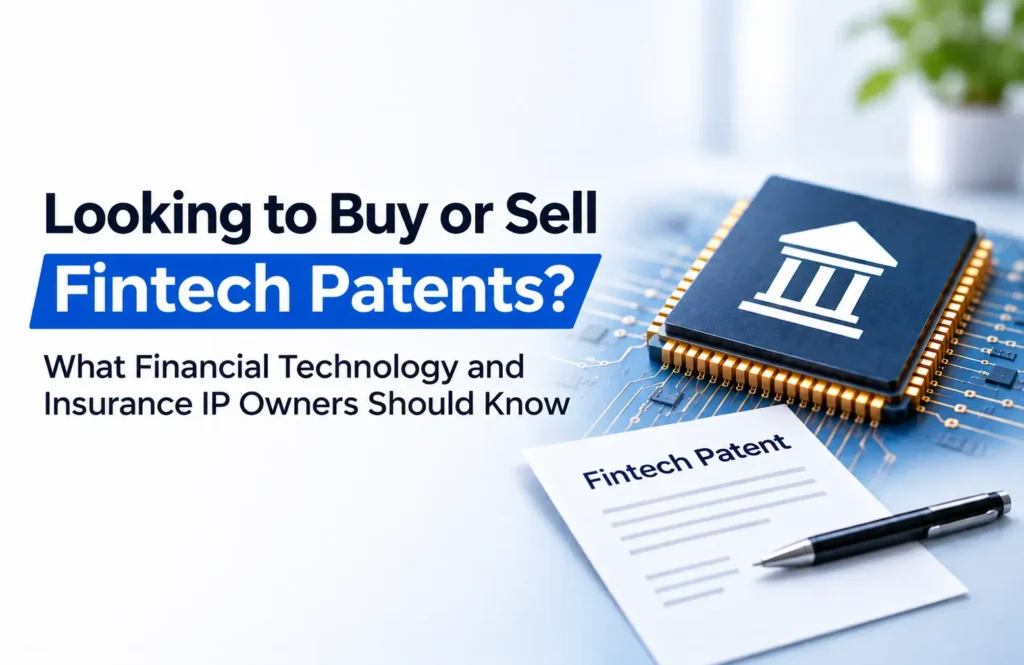
Financial services run on technology. Digital payments, online banking, fraud detection, digital lending, authentication and insurance platforms all rely on software that companies have spent years developing and protecting. As a result, patents have become a business asset in fintech and insurtech.
Some owners hold patents that no longer match their product plans. For others, buying an existing patent may be the quicker way to strengthen a roadmap. But a patent sale or license involves more than a document.
Both sides need to look closely at the claims, IP ownership rights, legal status, technology relevance, market opportunity and competing IP. This article explains how to evaluate these opportunities with clear commercial goals in mind.
What Types of Fintech and Insurance Technology Patents Can Be Commercialized?
Patents in this space cover many kinds of technology. In financial services, they often relate to digital payment processing, transaction authentication, fraud detection, financial data processing, digital banking systems, lending technologies, financial analytics and automated services. In insurance, they can cover automated claims processing, risk assessment, underwriting, policy administration, customer verification and insurance data analysis.
Some technologies, such as fraud detection, show up in both sectors. The industry label alone does not decide commercial value. What matters is what the patent claims actually cover and whether that technology is used or needed in the market. A claim on a specific method of verifying customers for example, may interest insurers, banks and technology companies alike.
Owners should look at uses beyond the original product but should not assume every use will work commercially. Buyers should check that the technology solves a real business or technical need before moving ahead with a purchase.
Also Read: The $600 Million Netlist–Micron Patent Deal: How AI Memory Patents Can Generate Licensing Revenue
Why Would a Company Want to Buy Fintech Patents?
A company may buy fintech patents when its R&D roadmap calls for a technology that already exists as a patented asset. Buying it can give a company an established IP asset to build on instead of developing every element itself, though this does not automatically save time or money. Buyers also look for patents that fit well with their current portfolio.
A payments company for example, may review patents on authentication or transaction processing that fit its existing systems. Another reason is a gap in internal capability or IP position, where buying a patent is one way to address it. In every case, the decision should depend on technical relevance, claim scope, IP ownership rights, legal status and the company’s commercial goals.
Why Fintech Patent Owners Sell or License Their IP
Patent holders often hold technology that no longer fits their product roadmap. Rather than leaving that IP idle, they can explore ways to commercialize it. There are two main routes. Under a licensing deal, the owner keeps ownership of the IP and gives another party defined rights on agreed terms.
Those terms can cover territory, duration, field of use, exclusivity and royalties. With a patent assignment, ownership passes to the buyer and the agreement should clearly lay out the rights, obligations and legal requirements involved.
An owner who wants to remain involved in the technology may favor licensing while one ready to give up IP ownership rights may choose assignment. The right structure depends on the portfolio, the commercial opportunity and the owner’s goals.
What Should Buyers Review Before Acquiring Fintech Patents?
Before acquiring a fintech patent, buyers need to look beyond the technology itself and check how strong and usable the asset is. The points below cover what to review.
1.) Review the Patent Claims
Buyers should start with the patent claims not the title or abstract. The title and abstract give a general idea of the innovation, but the claims define what the patent actually protects.
Reading them closely shows what is covered and what is not.
Buyers should then ask whether that claimed technology is relevant to their intended product, service or technology. A patent that sounds right on paper may not fit the buyer’s needs once the claims are reviewed.
2.) Verify Ownership and Legal Status
Buyers should confirm who owns the patent today. Check the assignment records, registration details and the countries where the patent is in force. Verify that maintenance or renewal fees are up to date where this applies. Existing encumbrances or rights, such as licenses or security interests, could also affect the deal.
Unclear ownership can delay a deal or lead to problems after it closes, so it is best to settle these points early, before any commercial agreement is signed.
3.) Assess Technical and Commercial Relevance
The technical assessment should show whether the patented technology can work with the buyer’s current systems or development plans. Buyers should check whether the technology solves a real business problem and whether it can fit in with existing systems. It also helps to check if it fits the company’s R&D roadmap.
Lastly, look for clear commercial uses, such as a product, service or licensing opportunity. If these answers are weak, the patent may add little commercial value even when the claims look solid.
4.) Consider the Competitive IP Environment
Looking at related patents early on can show buyers whether the target technology sits in a crowded area or stands apart from the rest. A more detailed patent landscape analysis may be appropriate where the competitive position needs closer examination.
Rival companies may already hold rights in the same space, so buyers should get to know the surrounding IP before deciding if the patent fits their plans.
Also Read: Protecting the Design Is Only the Beginning: How Car Design Patents Support Commercial Strategy
What Patent Owners Should Evaluate Before Selling or Licensing
Before putting a patent on the market owners should be clear about what they hold and what they want from a deal. The points below cover what to assess first.
1.) Understand the Portfolio’s Commercial Relevance
Owners should go through their full patent portfolio before approaching the market. Begin with the assets linked to active or emerging technology areas, as these are more likely to attract a buyer’s interest.
After that, divide the patents that are strategically important to the company from those that no longer serve its business direction. This gives owners a clearer picture of what to keep, what to license and what to think about selling.
2.) Evaluate Potential Commercial Counterparties
Owners should think about who could actually use the technology. Depending on the patent, interested parties may include fintech companies, banks, insurers, insurtech businesses, payment providers and technology companies.
Other businesses with relevant product applications may also come into play. Identifying these groups early lets owners focus on companies with a genuine need rather than reaching out to buyers or licensees who have little reason to be interested.
3.) Prepare the IP for Commercial Discussion
Before approaching a buyer or licensee, owners should have the key details ready. This includes the relevant patent claims, a clear technology description, legal status, ownership information, geographic coverage, potential applications and any related IP assets.
The aim is to make the opportunity simple to follow. Owners should also take care not to overstate the patent’s value or commercial prospects. A clear, honest presentation builds trust and helps the other side decide whether the technology suits their needs.
Patent Landscape and Freedom-to-Operate: Why They Matter in Fintech Transactions
A patent landscape shows the wider IP picture. It can reveal competing technologies, related patents, major patent holders and technology trends which helps when judging an acquisition or commercialization opportunity. Freedom to operate (FTO) asks a different question: could a specific product, process or activity infringe someone else’s patent?
Buying a patent does not automatically give a company the right to commercialize its product, since third-party patent rights may still apply. That is why buyers should not treat the two analyses as the same. One looks at the broader environment, the other at infringement risk, and each supports a different decision.
How Should Buyers and Sellers Evaluate the Commercial Potential of a Fintech Patent?
After the initial IP and technical evaluation, buyers and sellers need to consider whether the asset has a realistic commercial pathway. This means considering the possible applications, the companies that may have a reason to use the technology, the strength of the market behind it and where the asset fits in a wider technology or IP strategy.
A commercially relevant opportunity needs a clear use case and counterparties who stand to benefit from the technology. Related patents, complementary technologies or a broader portfolio can add to its strategic value. Together, these factors indicate whether further talks on licensing, acquisition or commercialization are worth pursuing.
Real-World Example: Buying a Fintech Patent Portfolio
Imagine a financial technology company that is developing a new digital payment platform. While doing so, it discovers an outside portfolio with patents on transaction authentication and fraud detection.
The company measures the portfolio against its product roadmap to find out whether the technology fills a capability gap that its existing IP and R&D resources cannot properly cover.
This review helps the company decide whether the portfolio deserves further transaction and technical diligence. The portfolio may complement its existing IP or only a few patents may be worth acquiring. Licensing might suit the company better than buying or the review may show that more technical or legal diligence is needed. Acquisition is only one possible outcome of a structured evaluation.
How Patent Monetize Can Help Connect Fintech IP With Commercial Opportunities?
Patent Monetize is a marketplace where patent holders can present IP and technology opportunities to potential commercial counterparties. This includes fintech, insurance technology and broader technology portfolios. Buyers can also use the platform to discover external patents and technologies that match their R&D needs, product strategy, IP portfolio or technology gaps.
The platform can help owners present these opportunities to potential counterparties while giving prospective buyers a place to discover external IP that may align with their technology requirements. A listing does not guarantee a deal but it helps with discovery, connection and commercial evaluation.
If you own fintech or insurance technology patents and are evaluating licensing, assignment or other commercialization opportunities, explore Patent Monetize to present your IP to potential commercial counterparties.
The Bottom Line
Buying or selling a fintech patent takes more than finding an asset and agreeing on a deal. Buyers need to understand the claims, legal position, technology relevance, competitive environment and commercial fit. Owners need to know which assets have real commercial potential and which structure suits their goals whether that is licensing, assignment, internal use or a strategic partnership.
The appropriate transaction should ultimately reflect the strength of the IP, its practical application and the commercial objectives of the parties.
Patent Monetize supports this process as a platform where owners can present relevant IP and buyers can discover opportunities that match their technology and business needs.
Search
Categories
Recent Post
-
 Roche’s Potential $813 Million Drug Licensing Deal: Lessons for Biotech Patent Commercialization
-
 Looking to Buy or Sell Fintech Patents? What Financial Technology and Insurance IP Owners Should Know
-
 The $600 Million Netlist–Micron Patent Deal: How AI Memory Patents Can Generate Licensing Revenue
-
 Protecting the Design Is Only the Beginning: How Car Design Patents Support Commercial Strategy
-
 Build or License? The IP Strategy Automotive Companies Should Consider Before Investing in New Technology