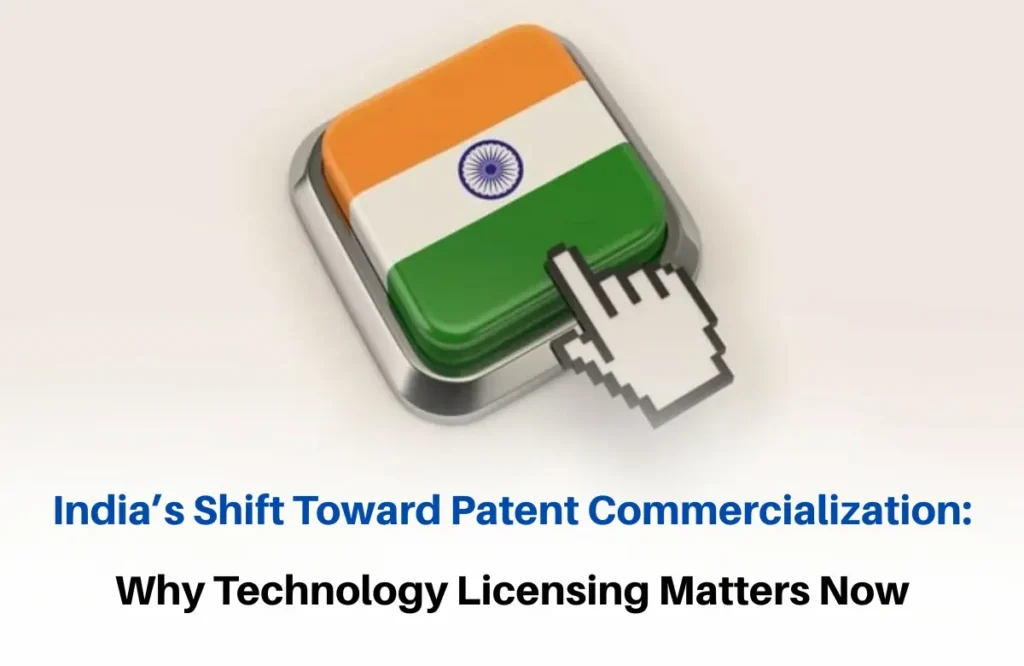
For years, the intellectual property conversation in India focused almost exclusively on filing. Government bodies and private entities encouraged inventors to secure legal protections and grow their portfolios but they not telling about Patent Commercialization, the best way to generate income through patents. However, this left a critical question: what happens after the Controller General grants a patent?
Statistics suggest that many patented technologies never reach the market. While an invention may possess significant industrial utility, the patent holder often lacks a manufacturing partner or the expertise to initiate Patent licensing negotiations. Consequently, valuable intellectual property remains underutilized.
The Government of India recently addressed this gap by launching the IP Catalyst platform. This initiative facilitates the transition of patents and publicly funded research into the commercial sector through structured Patent Commercialization, technology transfers, and licensing support. We are seeing a necessary shift in priority: the focus is moving from the mere acquisition of rights to the actual exercise of those rights.
The Economic Value of Statutory Rights
A patent by itself is a legal right. But the real business value of a patent comes when the technology is actually implemented in the market. Under the right framework, a patent functions as:
- A licensed technology generating royalty streams.
- A basis for joint ventures or manufacturing agreements.
- A transferable business asset.
- The legal foundation for a new corporate entity.
Despite these benefits, many stakeholders struggle with the commercialization phase. Individual inventors often lack access to industrial networks, and research institutions frequently hold vast portfolios without a dedicated pathway to market.
Read Also: Maximizing the Monetary Value of Expiring and Dormant Patents: Facilitated by Patent Monetize
Transitioning to an Innovation-to-Industry Model
The Indian government’s emphasis on commercialization indicates that the nation is looking beyond filing statistics. The goal is now industrial adoption. This is vital for sectors such as infrastructure, healthcare, and clean energy, which require constant technical upgrades.
Global and domestic markets currently hold thousands of technologies available for licensing. However, these assets only create value if a bridge exists between the patent proprietor and the industry.
How Patent Monetize Supports This Transition
Patent Monetize aligns with this national objective. We assist patent holders in identifying commercialization opportunities through formal Patent licensing and technology transfer. Our role is to ensure that a patent does not simply exist on a ledger but reaches a manufacturer or investor capable of implementing it.
Many patent owners understand the technical merits of their work but require professional assistance regarding:
- Identifying relevant industrial sectors for application.
- Due diligence on potential licensees.
- The legal structure of licensing agreements.
- Negotiation strategies for commercial partnerships.
The Future of the Indian IP Ecosystem with Patent Commercialization
India has demonstrated significant growth in its startup and innovation sectors. The next logical phase is ensuring these innovations achieve commercial success. This evolution requires increased industry participation, clearer licensing frameworks, and accessible platforms for technology transfer.
The launch of the IP Catalyst platform confirms that commercialization is now a matter of national economic policy. For universities and corporations alike, the strategy must evolve. The success of an innovation is measured not by the grant of a patent certificate, but by its integration into the marketplace.
At Patent Monetize, we facilitate the link between legal intellectual property Rights and industrial application to ensure your research produces a tangible return on investment.
Recent Post
-
 188 Patents, One Licensing Strategy: How Patent Portfolios Are Being Built for Commercialization?
 -
 AWS’s $1 Billion + IP Licensing Deal: Why Companies License Technology Instead of Building Everything In-House
 -
 Huawei Signs Multi-Year Patent License Deal with Qualcomm Covering AI & 5G, Expected to Push Licensing Value Past $6.9 Billion
 -
 Hassle-Free Closures: How Patent Monetize Manages Everything from Listing to Legal Closure
 -
 Types of Patent Licensing: Exclusive, Non-Exclusive, and Sole Licenses Explained