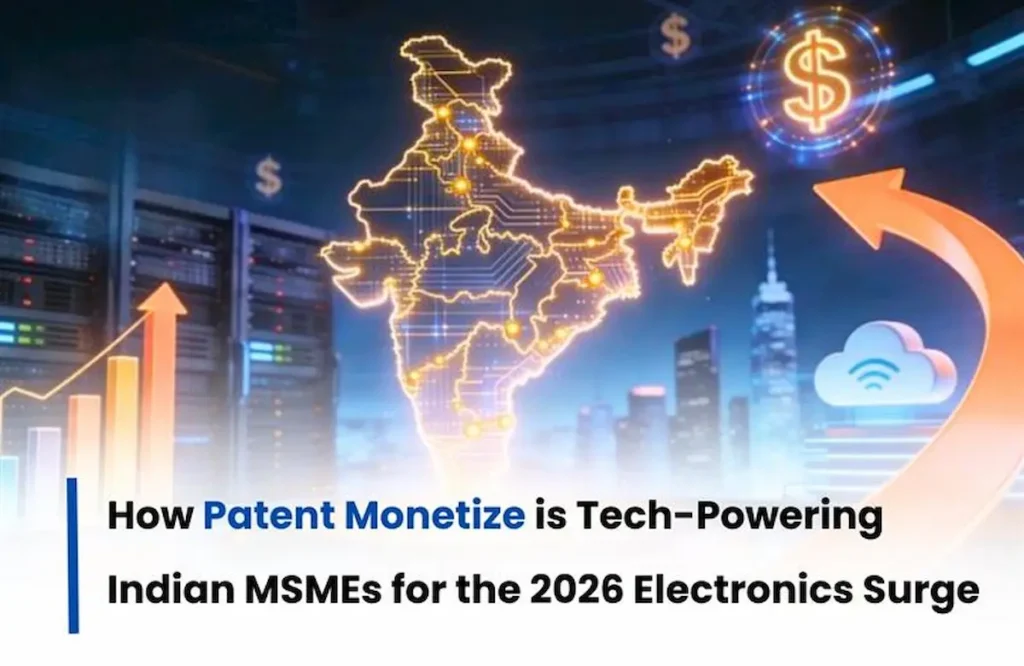
As India moves closer to the 2026 fiscal year, the national landscape for electronics manufacturing is undergoing a profound structural shift. With the Union Budget 2026 allocating significant outlays for semiconductor and electronic component manufacturing, the sector is no longer just about assembly; it is about original innovation. For Indian MSMEs. Patent Monetize has emerged as a specialized catalyst in this ecosystem, ensuring that the effective Patent Monetization and tech-powered MSMEs can transition from being local manufacturers to becoming global intellectual property (IP) leaders, this era represents a critical juncture where survival depends on the ability to protect and leverage intellectual property.
The Role of Intellectual Property in Scaling Tech-Powered MSMEs
The surge in electronics production, projected to reach billions in value by 2026, has created a high-stakes environment for technical innovation. In this competitive market, tech-powered MSMEs often hold valuable inventions but lack the legal or financial infrastructure to defend them against larger conglomerates. This is where the strategic implementation of Patent Monetization becomes essential. By treating a patent not just as a legal document but as a liquid financial asset, small enterprises can secure the capital necessary to scale their operations. Patent Monetize facilitates this by providing a streamlined IP marketplace where these smaller entities can list their innovations for acquisition or licensing by industry giants.
Navigating the Legal Landscape for Indian MSMEs in 2026
The Indian government has significantly reformed the IP regime, reducing filing fees and accelerating examination timelines to support the growth of Indian MSMEs. Successfully securing a patent certificate represents merely the beginning of a much larger commercial journey. To truly benefit from the 2026 electronics boom, these businesses must understand the nuances of enforcement and Patent commercialization. Patent Monetize acts as a legal and technical bridge, ensuring that the contractual frameworks for Patent Monetization are robust and legally sound. This protective layer allows tech-powered MSMEs to share their technology with partners without the risk of losing their core intellectual rights, thereby fostering a safer environment for collaborative innovation.
Strategic Patent Monetization for Sustainable Revenue Streams
For a micro or small enterprise, R&D is a heavy investment that often takes years to yield returns. Through the process of Patent Monetization, these companies can generate recurring revenue even before their own products hit the mass market. By licensing their niche electronic components or software algorithms to larger manufacturers, Indian MSMEs can create a steady cash flow that fuels further research. Patent Monetize specializes in matching these specific technical assets with the right buyers, ensuring that the Patent valuation reflects the true market potential of the technology within the 2026 electronics surge.
Future-Proofing Growth for All Tech-Powered MSMEs Nationwide
As we look toward the 2026 horizon, the distinction between a traditional manufacturer and a modern innovator is becoming clear. The most successful tech-powered MSMEs will be those that integrate IP management into their core business strategy. By leveraging platforms like Patent Monetize, Indian MSMEs can ensure they are not left behind as the industry evolves. This support system provides the transparency and expertise needed to navigate complex negotiations, making the global IP market accessible to even the smallest player in the Indian electronics sector.
Read Also: China Steps Up Patent Commercialization to Drive Innovation Growth
Evolution of Market Design: Assessing the Shift in Technical Standards
To understand the progress made by Indian MSMEs, it is helpful to look at how technical design standards have evolved, much like the transition seen in modern automotive engineering between internal combustion and electric vehicles. In the previous decade, the design focus for electronics was primarily on “Functional Utility,” where the goal was to create durable, single-purpose components with basic circuitry. However, as we approach 2026, the design philosophy has shifted toward “Integrated Intelligence.”
The “Functional Utility” design was characterized by larger form factors and standalone hardware that required manual integration. In contrast, the 2026 “Integrated Intelligence” design, championed by tech-powered MSMEs, focuses on miniaturization, IoT connectivity, and modularity. This newer design approach requires a much higher density of intellectual property protection, as the value lies in the software-hardware interface rather than just the physical materials. While the older design was easier to replicate, the modern, intelligence-driven design is inherently more defensible through IP laws, providing a stronger foundation for long-term commercial success in the global market.
Recent Post
-
 188 Patents, One Licensing Strategy: How Patent Portfolios Are Being Built for Commercialization?
 -
 AWS’s $1 Billion + IP Licensing Deal: Why Companies License Technology Instead of Building Everything In-House
 -
 Huawei Signs Multi-Year Patent License Deal with Qualcomm Covering AI & 5G, Expected to Push Licensing Value Past $6.9 Billion
 -
 Hassle-Free Closures: How Patent Monetize Manages Everything from Listing to Legal Closure
 -
 Types of Patent Licensing: Exclusive, Non-Exclusive, and Sole Licenses Explained