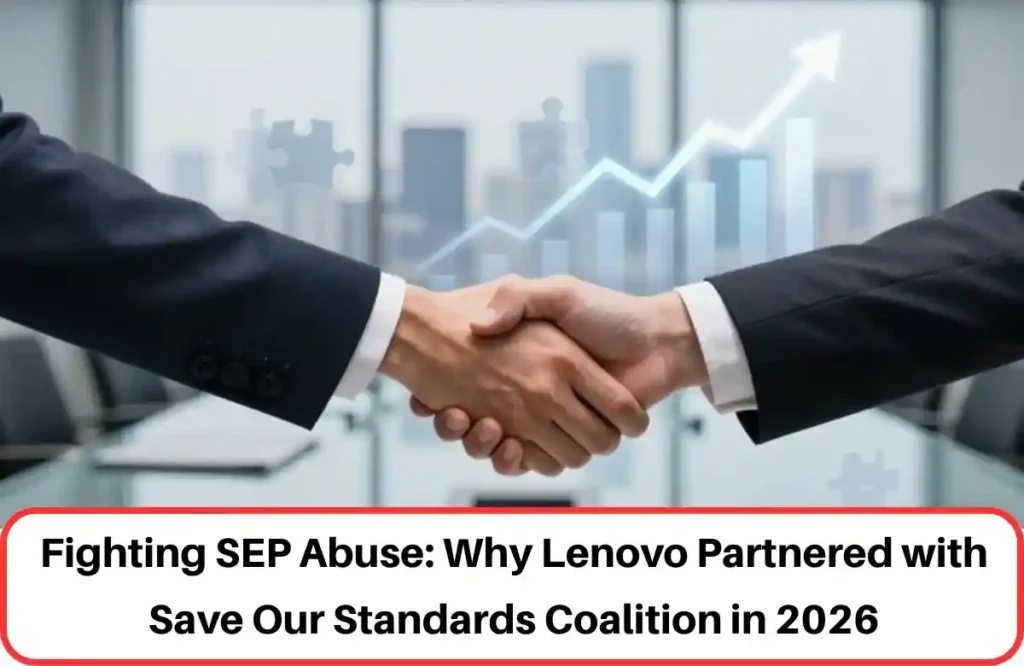
Lenovo Join Save Our Standards: Innovation faces a critical bottleneck. It isn’t an engineering problem; it’s a legal one. Standard Essential Patents (SEPs), the IP required to comply with core technical standards like 5G, Wi-Fi, and video compression, originally aimed to standardize baseline technology across the industry. But predatory licensing practices have corrupted this system. We see this acute friction globally. For instance, executing patent licensing in India and other rapidly expanding digital economies has become a high-stakes corporate chess match. When SEP holders weaponize these assets via inflated royalty demands or sudden injunctions, the entire consumer technology supply chain suffers.
Because of this escalating litigation, Lenovo took definitive action. In 2026, the PC and smart device leader formally joined the Save Our Standards (SOS) coalition. Why? To demand strict adherence to Fair, Reasonable, and Non-Discriminatory (FRAND) terms. This isn’t just about protecting Lenovo’s own inventory. It’s a direct pushback against anti-competitive asset enforcement.
The Weaponization of SEPs and the Need for FRAND Integrity
Historically, a tacit consensus governed SEPs. Patent holders contributed IP to a standard, promising to license those assets on FRAND terms. It worked. Creators received equitable compensation, and licensees manufactured compliant hardware without monopoly risk.
But compliance is breaking down. Today, we routinely encounter “patent hold-up.” This occurs when a patent owner demands extortionate royalties after an industry has already widely adopted a standard. It creates severe financial risk for companies like Lenovo that integrate thousands of standard-compliant parts into a single device. If negotiations stall, Patent Assertion Entities (PAEs) seek immediate injunctions and asset seizures. It’s an unsustainable model. And it’s exactly why transparent, objective valuation must return to the market before legal costs completely suppress R&D.
Read More: Establishing Legal Predictability Under the Huawei Wi-Fi 7 Patent Licensing Program
A Unified Front for Proportionality and Global Market Stability
Lenovo’s shift from defensive litigation to systemic reform signals a broader corporate trend. The SOS coalition lobbies for a crucial legal baseline: royalty calculations must depend on the specific component’s value, not the retail price of the complete end-user device. Think about it. Should a 5G patent fee reflect the cost of a base microchip, or the retail price of a premium enterprise laptop? The answer is obvious.
By joining SOS, Lenovo builds leverage with antitrust regulators and judiciaries to enforce clear definitions of “good faith” bargaining. It’s about protecting market stability. Ultimately, commercial success should depend on product performance and consumer value, not the scale of your litigation budget.
Redefining the IP Ecosystem: A Sustainable Way Forward
Lenovo’s actions highlight a stark reality for the modern C-suite. Management of an intellectual property portfolio demands structural clarity and fair-market terms. When old, adversarial licensing approaches fail, your organization shouldn’t rely on high-risk, opaque negotiations that invite regulatory scrutiny. The market needs a clean, neutral pipeline for transactional execution.
This is where structured commerce changes the dynamic. Patent Monetize is a global intellectual property (IP) marketplace that connects inventors, startups, and enterprises with worldwide buyers, licensees, and investors to turn patented assets into revenue via assignment or licensing structures. By establishing a secure, objective patent marketplace, we provide the legal and logistical framework required to execute transactions safely. It’s an approach that reflects the exact equitable values that SOS champions.
Read More: Nokia Lenovo cross-license agreement to Drive Tech Innovation
You don’t have to manage international IP transfers in isolation. Our platform handles the entire transactional lifecycle end-to-end, including market analysis, valuation, strict non-disclosure compliance, and final closing documentation. This lets your legal and engineering teams prioritize core innovation. Whether you require structured, recurring royalty streams or an outright asset divestment, the process no longer requires aggressive, high-risk strategies. By processing transactions through a vetted, global network, Patent Monetize guarantees that intellectual property acts as a predictable mechanism for corporate liquidity and commercial growth.
Recent Post
-
 Hassle-Free Closures: How Patent Monetize Manages Everything from Listing to Legal Closure
 -
 Types of Patent Licensing: Exclusive, Non-Exclusive, and Sole Licenses Explained
 -
 How Patent Monetize Helps International Tech Owners Capture Massive Consumer Bases
 -
 Fighting SEP Abuse: Why Lenovo Partnered with Save Our Standards Coalition in 2026
 -
 Asus and Nokia End Video Coding Litigation with Global Patent Licensing Deal