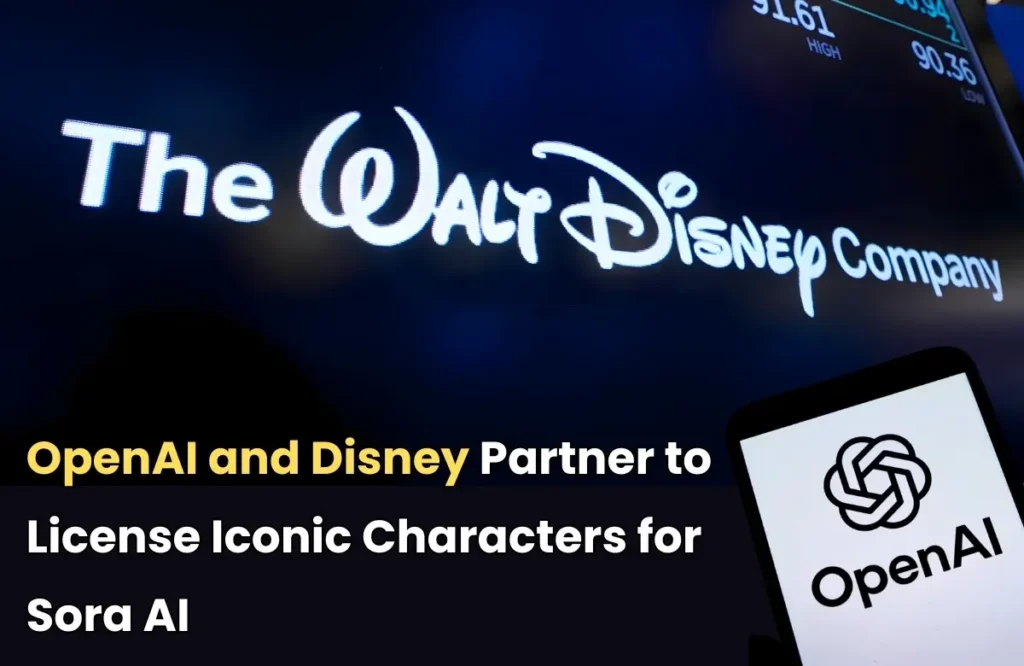
The Walt Disney Company and OpenAI have finalized a definitive three-year strategic partnership, establishing a formal framework for the integration of Disney’s proprietary assets into OpenAI’s generative AI platforms. The Disney and OpenAI licensing agreement marks a transition from industry-wide litigation toward a structured model of cooperation, allowing for the authorized use of Disney’s intellectual property (IP) within Sora, OpenAI’s text-to-video tool. This Patent Licensing agreement represents a landmark in the evolution of digital media, specifically addressing the intersection of generative technology and established copyright law.
The Structural Framework of the Disney and OpenAI licensing agreement
Under the terms of the Disney and OpenAI licensing agreement, Sora is authorized to generate short-form, user-prompted videos utilizing a catalog of approximately 250 characters. This selection spans Disney’s most valuable franchises, including assets from Marvel, Pixar, and Star Wars. The agreement provides a specific mandate for the creation of fan-inspired social content, which both parties expect to roll out in early 2026.
Read Also: Licensed Technology vs In-House R&D: A Strategic Comparison
To ensure technical and legal clarity, the agreement outlines several critical parameters:
- Licensed Asset Scope: The license is restricted to animated, creature, and masked characters, alongside their associated environments, props, vehicles, and costumes.
- Exclusion of Likeness and Voice: To maintain high standards of IP protection, the agreement expressly excludes the use of talent likenesses and human voices. This boundary is designed to protect the publicity rights of individual performers.
- Output Restrictions: Users are permitted to generate 30-second videos, ensuring that AI-generated content remains distinct from Disney’s primary cinematic and television productions.
- Curated Distribution: Disney will curate a selection of Sora-generated videos for distribution on the Disney+ streaming platform, maintaining editorial oversight over the final output.
Strategic Patent Licensing and Corporate Integration
The partnership extends beyond a standard content license, involving a significant financial and operational alignment between the two entities. As part of the transaction, Disney has committed to a $1 billion equity investment in OpenAI, accompanied by warrants for the purchase of additional equity. This move transitions Disney from a traditional licensor to a strategic stakeholder in the underlying technology.
This alignment facilitates patent licensing in a way that benefits Disney’s internal infrastructure:
- API Utilization: Disney becomes a major enterprise customer of OpenAI, utilizing its APIs to develop new products and consumer tools.
- Internal Productivity: The company will deploy ChatGPT for its employees to streamline internal administrative and creative workflows.
- Enterprise Customization: Disney will leverage OpenAI’s models to power bespoke experiences for Disney+ subscribers, integrating AI-native features directly into the streaming ecosystem.
The Role of Patent Monetization and IP Protection Standards in the Disney and OpenAI Licensing Agreement
By formalizing this relationship, Disney is pursuing a strategy of patent monetization that leverages its existing IP library to generate new revenue streams via generative platforms. This proactive approach allows the company to define the terms of use rather than reacting to unauthorized third-party training data usage.
The Disney and OpenAI licensing agreement emphasizes a shared commitment to “responsible AI,” which includes:
- Brand Safety Guardrails: OpenAI has committed to implementing age-appropriate policies and reasonable controls to prevent the generation of harmful or off-brand content.
- Rights Holder Governance: Both companies will maintain robust controls to respect the rights of content owners in relation to the outputs generated by the models.
- Technical Provenance: The collaboration includes the implementation of watermarking and metadata standards to ensure the transparency and origin of AI-generated Disney content.
Future Implications for the Disney and OpenAI Licensing Agreement
The implementation of this agreement confirms that rigorous IP protection and technological innovation are compatible objectives within a structured legal environment. The Disney OpenAI licensing agreement establishes a contractual governance model where specific rights, limitations, and platform-level enforcement act as the primary mechanisms for managing intellectual property assets. As the launch date of early 2026 approaches, the industry will likely view this partnership as the legal benchmark for the commercialization of proprietary story worlds within generative AI environments. This transaction effectively moves AI from a disruptive variable to a regulated asset within the global media sector.
Recent Post
-
 China Steps Up Patent Commercialization to Drive Innovation Growth
 -
 Patent Royalties Explained: How Much is Your Invention Really Worth?
 -
 The Significant Role of Technology Transfer Companies in India
 -
 The Ultimate Guide to Buying and Selling a Patent: 7 Pro Tips for Success
 -
 Monetization of Green Ideas: Why Earth-Friendly Patents Are Worth More Money