OUR SOLUTIONS / TECHNICAL INVESTIGATION

Product Testing
& Reverse Engineering

Understand the implementation. Establish the evidence. Inform the next decision.

Patent Monetize develops product testing and reverse engineering investigations for corporate IP teams, patent owners, licensing organisations, and law firms handling technically complex matters.

Corporate IP teams · Patent owners · Law firms
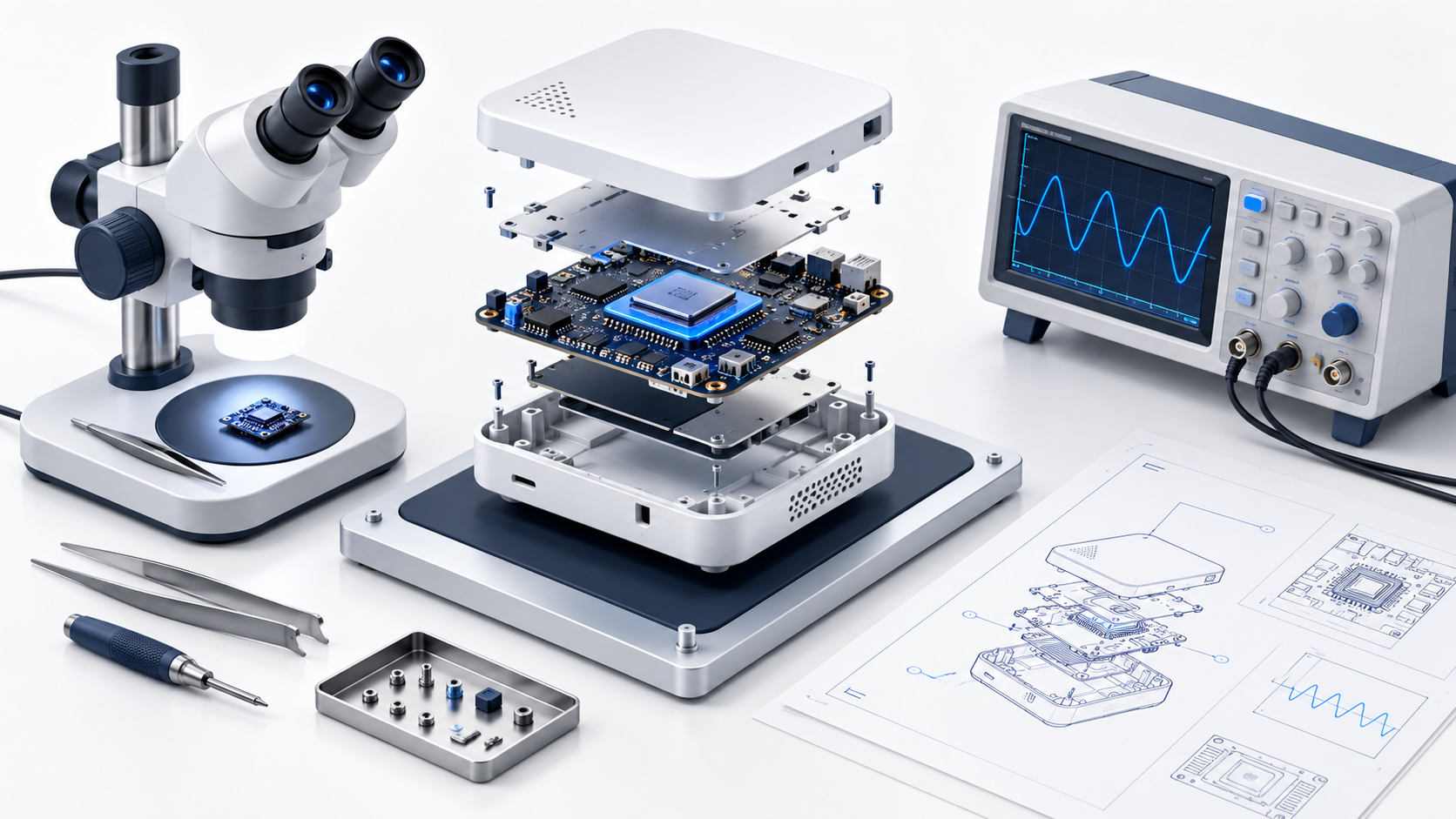
Conceptual illustration of electronic device teardown, microscopy and waveform testing
TEST / EXAMINE / DOCUMENTA clear view of the implementation.
UNDERSTAND THE SOLUTION

What Is Product Testing & Reverse Engineering?

Our solution examines how a selected product is constructed, how its components interact, and how it behaves under defined conditions. We connect those findings to the technical questions that matter to your assignment—whether you are investigating patent use, strengthening a patent claim chart, assessing a licensing opportunity, or reviewing a competing technical explanation.

The investigation begins with a specific question. We identify what must be established, select an appropriate method, document the observations, and explain how far the resulting evidence supports the proposed conclusion.

Product testing: examining operation under defined conditions

Product testing investigates how a device, application, system, or process responds to controlled inputs and operating conditions.

For a patent matter, the objective may be to determine whether a particular operation occurs, what triggers it, which components participate, or whether a measured parameter corresponds to a claim requirement.

We structure testing around these questions and record the configuration, procedure, observations, and limitations needed to understand the results.

Reverse engineering: investigating the underlying implementation

Reverse engineering examines a product’s architecture, internal structures, component relationships, or software operation to understand how it achieves a particular result.

An investigation may progress from external inspection and functional observation to disassembly, circuit analysis, authorised software examination, or specialist material characterisation.

Product testing and reverse engineering complement one another. Testing may reveal what a product does; deeper examination may help establish the mechanism responsible for that behaviour.

THE QUESTIONS WE INVESTIGATE

What Your Investigation Can Establish

An appropriately scoped investigation can help answer questions such as:

Which implementation is present?

Identify relevant components, structures, interfaces, and operating mechanisms within the selected product.

How does the feature operate?

Examine the inputs, conditions, sequence of events, and outputs associated with a particular function.

What evidence supports the patent mapping?

Develop observations and measurements relevant to specific claim limitations.

Does an alternative explanation fit the results?

Test competing technical hypotheses rather than relying on a single assumed mechanism.

Where does the evidence remain incomplete?

Identify inaccessible internal functions, inconclusive measurements, or documents needed for further analysis.

How do products or versions differ?

Compare selected models, configurations, or software releases without assuming that one represents every implementation.

The findings may support a proposed mapping, contradict it, or leave a question unresolved. Each outcome is recorded clearly.

DETAILED SOLUTION SCOPE

Our Product Testing & Reverse Engineering Solution Scope

1. Claim-Focused Investigation Planning

We review the selected patent claims and identify the technical facts that require investigation.

For each relevant limitation, we consider what can be observed externally, what requires internal examination, and what may depend on confidential documents or additional access.

The resulting plan connects each investigation activity to a defined question, expected evidence, and decision point. This helps avoid spending time on measurements that do not resolve a material issue.

2. Product Identification and Baseline Assessment

Before testing begins, we establish the identity and condition of the sample.

Records may include the manufacturer, model number, serial number, hardware revision, firmware version, acquisition source, accessories, and initial operating state.

We also document configuration settings and environmental conditions that could affect behaviour. Where several samples are available, the plan addresses how they will be allocated between baseline testing, comparative work, and destructive examination.

3. Functional and Behavioural Testing

We investigate the operation of selected features under documented conditions.

Testing may examine activation thresholds, event sequences, mode changes, response times, state transitions, output characteristics, or interactions between connected components.

Where appropriate, we vary one condition at a time, use comparison cases, and repeat observations to distinguish consistent behaviour from an isolated result.

The report explains whether the findings establish the claimed operation or merely remain consistent with it.

4. Physical Teardown and Component Examination

Where internal access is needed, we plan and document a staged teardown.

The examination can identify assemblies, component markings, physical arrangements, connection points, dimensions, and relationships between parts.

Photographs and annotations record the sequence of disassembly and the location of relevant features. Any alteration or damage introduced during examination is documented so that later observations can be interpreted correctly.

5. Circuit and Electronic-System Analysis

For electronic products, the investigation may address how relevant components are connected and how signals or power move through the system.

Depending on the assignment, analysis can include interface identification, connectivity checks, selected schematic reconstruction, control-path investigation, and correlation between measured electrical activity and product behaviour.

The scope distinguishes directly established connections from proposed relationships requiring further verification.

6. Embedded Systems and Firmware Investigation

For products whose operation depends on embedded software, we examine the relationship between hardware events, firmware-controlled functions, settings, and outputs.

Authorised investigation may include accessible logs, configuration records, update packages, supplied firmware, or technical documentation.

The analysis considers whether the observed behaviour is fixed, configurable, version-dependent, or influenced by external systems. Access restrictions and unavailable internal information are recorded.

7. Software and Application Testing

We investigate selected application functions using documented workflows and test conditions.

This may include data processing, user interactions, background operations, client–server exchanges, API behaviour, and changes across application versions.

Where authorised source code or design documents are available, they can be examined alongside runtime observations. We explain which conclusions follow from observed behaviour and which depend on internal implementation evidence.

8. Communication and Protocol Analysis

For connected products, testing may examine messages, transactions, timing, sequence, and responses between participating systems.

The investigation can use authorised captures, logs, interface records, and relevant technical specifications to identify the operation being performed.

Encrypted, inaccessible, or incomplete traffic is treated according to what it actually reveals. An inability to inspect message content is not replaced by an unsupported assumption.

9. Standards-Related Implementation Testing

We can structure investigations around selected provisions of a technical standard and the patent limitations associated with them.

The analysis identifies the applicable edition, optional or mandatory features, required configuration, and observable implementation behaviour.

Evidence that a product supports a standard is examined separately from evidence that it implements the particular feature relevant to the patent claim.

10. Specialist Structural and Material Examination

Some questions require methods beyond routine inspection or functional testing.

Where technically justified, the investigation plan may include optical microscopy, X-ray imaging, cross-sectional preparation, electron microscopy, elemental analysis, or other suitable characterisation methods.

The required specialists, equipment access, sample preparation, resolution, and expected output are established during scoping. We explain whether the proposed technique can resolve the relevant question before committing to deeper examination.

11. Comparative Product and Version Analysis

We compare selected implementations to identify meaningful technical differences.

Comparisons may address changes in component selection, architecture, operating conditions, software behaviour, or the presence of a relevant feature.

Where representative testing is proposed, we document why the selected samples are suitable and which conclusions cannot safely be extended to untested products.

12. Evidence Integration for Patent Claim Charts

Testing findings are organised against the selected patent limitations.

For each mapping, we identify the relevant observation, supporting record, technical explanation, and remaining uncertainty.

This integration helps counsel and IP teams understand how the investigation strengthens an existing patent claim chart, changes a proposed mapping, or identifies a need for further evidence.

FROM QUESTION TO TECHNICAL EVIDENCE

How We Conduct the Investigation

Stage 1: Define the Matter

We agree on the technical questions, selected products, relevant claims, intended use, and required deliverables.

The scope also addresses confidentiality, permitted access, sample availability, deadlines, and counsel’s instructions.

Stage 2: Assess Feasibility

We examine whether the question can be answered with the available product, documentation, tools, and access.

Where specialist work is necessary, we identify the proposed method, resources, anticipated limitations, and any sample-consumption risk.

Stage 3: Prepare the Test Plan

The plan records the hypothesis being investigated, test conditions, sample configuration, procedure, evidence to capture, and criteria for interpreting the result.

For quantitative measurements, we consider instrument suitability, calibration requirements, resolution, and relevant uncertainty.

Stage 4: Preserve the Baseline

We record the product’s initial condition and capture relevant configuration information before modifications or disassembly.

Where necessary, an unmodified comparison sample is retained to support later review.

Stage 5: Execute and Document

We perform the agreed examination and record the procedure, observations, deviations, and outputs.

Unexpected results are investigated rather than removed from the record.

Stage 6: Evaluate the Findings

We compare the results with the technical hypothesis, patent requirements, and available documentary evidence.

Alternative explanations and inconsistent observations are addressed explicitly.

Stage 7: Review and Report

The deliverable explains what was examined, how it was examined, what was found, and what the findings establish.

Where further investigation is needed, we provide a targeted plan.

Stage 8: Support the Next Step

We can clarify findings, organise supporting exhibits, update patent claim charts, and extend the investigation as new information becomes available.

QUALITY & TRACEABILITY

Evidence Handling and Investigation Quality

Documented sample history

We record sample identification, receipt, transfers, storage, examination, and material changes according to the agreed handling procedure.

Preserved digital records

Original files are retained separately from working copies and annotated outputs. Where required, file hashes, access records, and transfer logs support integrity checks.

Reproducible procedures

Test instructions document the inputs, settings, environment, tools, and sequence needed for another qualified reviewer to understand or repeat the work.

Measurement transparency

Quantitative findings identify units, instrument settings, relevant calibration information, and analytical limits. Precision is not presented beyond what the method supports.

Clear treatment of destructive work

Before destructive examination, we agree on the sample-use plan, preservation priorities, and records needed before the product is altered.

Independent technical challenge

The review examines whether the evidence supports the written conclusion, whether another explanation fits the observations, and whether missing information affects the result.

Confidentiality and controlled access

Handling requirements are defined for confidential documents, source code, samples, and investigation outputs. Counsel directs any protective-order or privilege arrangements.

REPORTS & DELIVERABLES

Reports and Deliverables

DeliverableWhat it includesHow your team can use it
Investigation scope and feasibility assessmentTechnical questions, proposed methods, required access, specialist requirements, and anticipated limitations.Decide whether and how to proceed with the investigation.
Detailed test planProcedures, conditions, sample configuration, evidence requirements, and interpretation criteria.Review the approach before testing begins.
Product testing reportTest setup, observations, measurements, results, deviations, and technical interpretation.Assess what the product does under the tested conditions.
Teardown and reverse engineering reportExamination sequence, relevant internal structures, component relationships, photographs, and findings.Understand the implementation behind the selected function.
Specialist examination reportSample preparation, analytical method, images or measurements, and interpretive limitations.Review questions requiring deeper structural or material analysis.
Annotated evidence packageMarked photographs, diagrams, captures, logs, screenshots, and test records.Locate and understand the evidence supporting each finding.
Patent claim mapping appendixFindings linked to selected claim limitations with precise evidence references.Develop or strengthen patent claim charts and Evidence of Use analysis.
Comparative implementation matrixDifferences across tested models, versions, or configurations.Determine where findings apply and where separate analysis is needed.
Evidence-gap and next-step reportUnresolved questions, their significance, and proposed additional investigation.Direct further testing or counsel-led information requests.
Executive technical summaryPrincipal findings, implications, uncertainties, and recommended actions.Support management, licensing, acquisition, or matter-planning decisions.

Deliverables can be provided in editable formats, PDF reports, spreadsheets, and presentation summaries according to the assignment.

COMMERCIAL & LEGAL APPLICATIONS

Where the Findings Can Be Used

Patent Licensing and Monetisation

Develop technical evidence connecting selected patent claims to commercial implementations and identify where additional investigation would strengthen licensing discussions.

Pre-Litigation Assessment

Help counsel evaluate the factual support for a proposed patent position and understand the technical issues before deciding on further action.

Litigation and Discovery Support

Organise product findings, exhibits, and unresolved questions for counsel’s use in case preparation, discovery planning, and review of opposing technical positions.

Defence and Technical Response

Investigate whether an alleged feature is present, whether a proposed mechanism is supported, and whether configuration differences or alternative explanations affect the mapping.

Patent Acquisition and Portfolio Review

Assess whether selected patents have demonstrable relevance to identifiable products and what investigation would be required to establish a stronger evidentiary position.

Competitive and Technology Assessment

Examine product architecture, operating mechanisms, and implementation differences to support an informed understanding of the technology.

Expert Review

Provide organised technical records for an appointed expert’s independent assessment. Expert opinions and testimony are separately defined where required.

TECHNOLOGY COVERAGE

Technology Areas We Can Assess

Investigation requirements may arise across:

Electronics and embedded systems

controllers, sensors, interfaces, power-management functions, and connected devices.

Software and digital platforms

applications, data workflows, APIs, distributed systems, and configurable functions.

Communications and networking

message exchanges, protocol operation, connected equipment, and standards-related behaviour.

Automotive and energy technologies

selected control systems, charging functions, monitoring equipment, and power-conversion implementations.

Industrial and mechanical products

assemblies, actuators, process equipment, automation, and operating sequences.

Semiconductor and material technologies

selected package structures, device features, layers, and compositions requiring appropriately scoped specialist examination.

Medical and diagnostic equipment

selected technical functions and architectures, with investigation boundaries defined for the product and intended use.

For each matter, the proposed scope specifies the technical disciplines, equipment, access, and specialist involvement required.

FROM FINDINGS TO ACTION

What Happens After Testing?

We translate the results into a practical action plan.

Where the evidence supports the proposed technical relationship, we can prepare the relevant mapping, strengthen exhibits, and identify related implementations worth examining.

Where the result is inconclusive, we explain what prevented a reliable conclusion and identify the next method or evidence source most likely to resolve the question.

Where findings contradict the proposed mapping, we record the reasons clearly so your team can reassess the claim selection, target, or investigation strategy.

A CONNECTED PATENT SOLUTION

Why Patent Monetize?

Our solution connects technical investigation with the broader patent decision.

We define the evidence needed before selecting the method, maintain product-specific records, and provide explanations that business teams, technical reviewers, and counsel can follow.

Assignments can be organised in stages, allowing deeper investigation to follow an initial feasibility assessment. Across larger portfolios or multiple products, a consistent reporting framework helps your team compare findings while retaining the detail specific to each implementation.

The result is an organised technical foundation: what was examined, what was established, what remains uncertain, and what should happen next.

Testing findings support technical assessment. Legal conclusions, admissibility, and litigation strategy remain subject to counsel’s review and the relevant forum.

DISCUSS YOUR REQUIREMENTS

Bring Us the Technical Question You Need to Resolve

Share the patent numbers, selected limitations, target products, available samples, and intended use of the findings.

Request a Product Testing & Reverse Engineering Assessment ↗

Define your investigation

Patent Monetize will define the investigation approach, evidence requirements, specialist needs, and reporting scope around your matter.