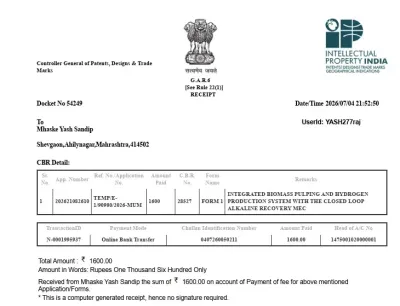
INTEGRATED BIOMASS PULPING AND HYDROGEN PRODUCTION SYSTEM WITH THE CLOSED LOOP ALKALINE RECOVERY MEC
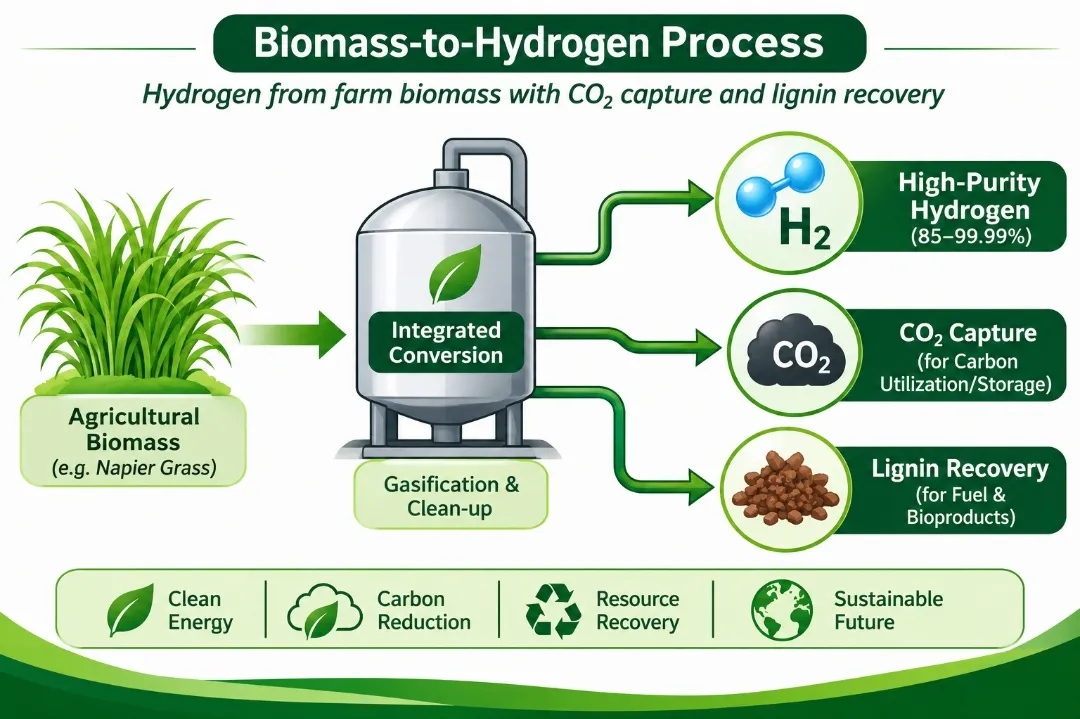
This invention is a new way to make hydrogen fuel from farm plants such as Napier grass and crop residue. Today, hydrogen from biomass is expensive because the whole plant goes into the gasifier, including parts that make no hydrogen, and capturing CO₂ needs separate equipment. In our method, the plant material is first cooked in a sodium hydroxide solution. This dissolves the lignin, the part that makes little hydrogen, and leaves a clean fiber. Only the fiber is turned into gas and shifted into hydrogen-rich gas. That gas is then passed back through the same solution, which captures the CO₂ and recovers the lignin in one step. The chemicals are then regenerated and reused in a closed loop, and the lignin and ash can be sold. The hydrogen is purified for industrial use. In our calculations this lowers the cost of biomass hydrogen compared with the conventional route, and it gives farmers a new buyer for their crops
Hydrogen is a clean fuel that industries such as refineries, fertilizer plants, and metal and glass processors need in large quantities. India wants to produce much more of it from green sources, but the existing methods of making hydrogen from farm waste are too expensive to be used at scale.
The main problem is that conventional biomass gasification feeds the whole plant (grass, crop residue, bagasse) into the gasifier. A large part of that material is lignin and ash, which produce little or no hydrogen, yet they occupy space and capacity in the most expensive machine in the plant. On top of this, capturing the CO₂ that is released usually requires a separate add-on system with its own equipment and cost. Valuable byproducts such as lignin, which can be sold for binders, resins and carbon materials, and ash are also wasted rather than turned into income.
Together, these problems push the modelled cost of hydrogen from conventional biomass gasification to about ₹168 per kg, which is too high for buyers to switch. As a result, the large amount of surplus crop residue available, about 14.8 million tonnes a year in Maharashtra alone and much of it burned or sold cheaply, is not converted into hydrogen on a meaningful scale.
This invention addresses the problem by pulping the biomass first, so that lignin is dissolved out and only the useful fiber is gasified, which allows a smaller gasifier. The resulting gas is then passed back through the same liquor used for pulping, so that CO₂ capture and lignin recovery happen in a single step. The chemicals are recycled in a closed loop, and lignin and ash are sold as extra income. In the founder’s model, this brings the cost down to about ₹133 per kg, and possibly ₹111 per kg if the fiber gasifies faster. These figures are model estimates, not measured results, and the pilot is designed to test them.
The invention is an integrated biomass pulping and hydrogen production system with a closed-loop alkaline recovery mechanism. Biomass such as grass, crop residue or bagasse is prepared and cooked with sodium hydroxide, dissolving the lignin into black liquor and leaving cellulose fiber. Only this fiber is dried and gasified, so gasifier capacity is not wasted on lignin and ash. The raw syngas passes through a water-gas shift reactor to raise its hydrogen content. The shifted gas is then bubbled through the retained black liquor, where carbon dioxide forms sodium carbonate and lignin separates, while hydrogen rises to the headspace and is purified by pressure swing adsorption. Causticizing and calcination regenerate the sodium hydroxide and calcium hydroxide, which return to the process in a closed loop. Lignin and ash are recovered as saleable byproducts. The novelty lies in integrating these known steps, so that one liquor performs pulping, CO₂ capture and lignin recovery. Modelled cost is about ₹133 per kg, and ₹111 per kg if the fiber gasifies faster, against ₹168 per kg for conventional biomass gasification
Yes. The invention addresses a gap in the prior art. Existing processes handle biomass hydrogen production, CO₂ capture and lignin recovery as separate operations. Conventional biomass gasification feeds the whole plant into the gasifier, so costly gasifier capacity is spent on lignin and ash that yield little hydrogen, and CO₂ capture is added later as a separate step with its own equipment. The LignoBoost process passes CO₂ through black liquor to precipitate lignin, but it is a lignin recovery process for pulp mills and does not produce hydrogen. Black-liquor gasification produces hydrogen, but it gasifies the liquor itself and not pulped fiber.
No known route combines these steps into one loop. This invention pulps the biomass first, gasifies only the cellulose fiber, and passes the shifted syngas back through the same alkaline liquor used for pulping. That single liquor performs pulping, CO₂ capture and lignin recovery, and its chemicals are regenerated and reused through causticizing and calcination. The gap addressed is therefore the lack of an integrated, closed-loop process that produces low-cost hydrogen from farm biomass while capturing CO₂ and recovering lignin in one step.
The process is unique because it integrates pulping, hydrogen production, CO₂ capture and lignin recovery into a single closed loop. Biomass is first pulped with sodium hydroxide so that lignin dissolves out and only the cellulose fiber is sent to the gasifier. This means gasifier capacity is not spent on lignin and ash, which allows a smaller gasifier or higher hydrogen output from the same machine. The shifted syngas is then bubbled through the same alkaline liquor used for pulping, so one liquor performs pulping, CO₂ capture and lignin recovery in one step, without separate capture equipment. Hydrogen does not dissolve in the liquor and is collected from the headspace for purification. Causticizing and calcination regenerate sodium hydroxide and calcium hydroxide, which return to the process, so chemicals are continuously reused. Lignin and ash are recovered as saleable byproducts, which lowers the net hydrogen cost. The process uses low-value farm biomass such as grass, crop residue and bagasse, and its modular design suits plants near industrial clusters. Modelled hydrogen cost is about ₹133 per kg, and ₹111 per kg if the fiber gasifies faster, against ₹168 per kg for conventional biomass gasification.
Industries where the invention can be useful?
ndustrial hydrogen supply and industrial gas distribution; petroleum refining (hydrotreating and hydrocracking); fertilizer and ammonia manufacturing; pulp and paper; agriculture and agro-processing, including sugar mills (bagasse) and crop residue management; chemicals and petrochemicals; metal processing, including steel, annealing and heat treatment; glass manufacturing; edible oil and food processing (hydrogenation of oils); electronics and semiconductor manufacturing; pharmaceuticals; renewable energy and clean fuels, including green hydrogen and biomass-based energy; lignin-based materials, including binders, resins, adhesives and carbon materials; waste management and biomass valorization; and transport and mobility fuels, such as hydrogen for fuel cell vehicles.An estimate of the total addressable market?
ndia’s hydrogen demand is about 6.9 million tonnes a year today and is projected to reach about 12 million tonnes a year by 2030, according to public MNRE, state and industry sources. In Maharashtra, the initial target region, demand is about 0.52 million tonnes a year today and is projected to reach 1.5 million tonnes by 2030. This could absorb about 1,400 plants of 365 tonnes per year (1,000 kg per day) today and about 4,100 plants by 2030. Refineries and fertilizer plants account for about 53% and 44% of national demand and are a longer-term segment, as a single plant of this size is small for them. The initial serviceable market is the remaining demand of about 3%, made up of industrial gas distributors and small and mid-size users such as metal and glass processing, edible oil hydrogenation, electronics and pharmaceuticals. This is roughly 0.2 million tonnes a year today and 0.36 million tonnes by 2030 nationally, equal to about 570 plants today and about 990 by 2030. At an illustrative price of ₹160 per kg, this serviceable market is worth about ₹3,300 crore a year today and about ₹5,800 crore a year by 2030. Lignin and ash sales add a separate byproduct marketPotential Customers/End Users. Who might benefit?
The main customers are industrial gas distributors, who buy hydrogen and deliver it by tube trailer to many small users, and small and mid-size industrial users such as metal and glass processors, edible oil hydrogenation plants, electronics manufacturers and pharmaceutical companies. Hydrogen project developers and green hydrogen buyers, including those responding to MahaGenco REL’s expressions of interest for its Uran project, are early prospects. At larger scale, refineries and fertilizer plants, which account for most of India’s hydrogen demand, could also use the hydrogen. Farmers benefit as a new buyer for grass and surplus crop residue, with about 150 to 300 farm households per plant. Lignin and ash buyers, such as makers of binders, resins, adhesives and carbon materials, form a byproduct market. Pulp and paper mills, sugar mills with bagasse, and biomass-rich industrial clusters are also potential users or licensees of the process. Technology developers, plant builders and investors can license or adopt the process for their own projects.
Actions
Added all portfolio
| Country | Current Status | Patent Application Number | Patent Number | Applicant / Current Assignee Name | Title | Google Patent Link |
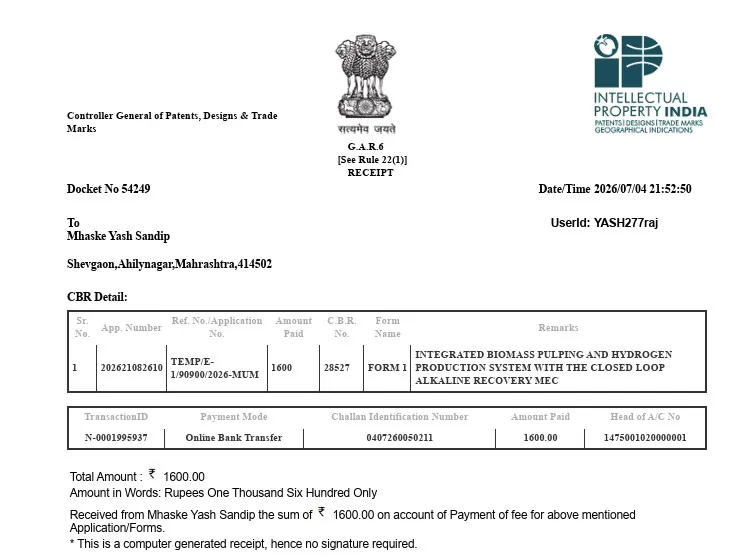
| India | Published - Pending examination | 202621082610 | Not mentioned | Mhaske Yash Sandip | INTEGRATED BIOMASS PULPING AND HYDROGEN PRODUCTION SYSTEM WITH THE CLOSED LOOP ALKALINE RECOVERY MECHANISM | Not mentioned |
You may also like the following patent