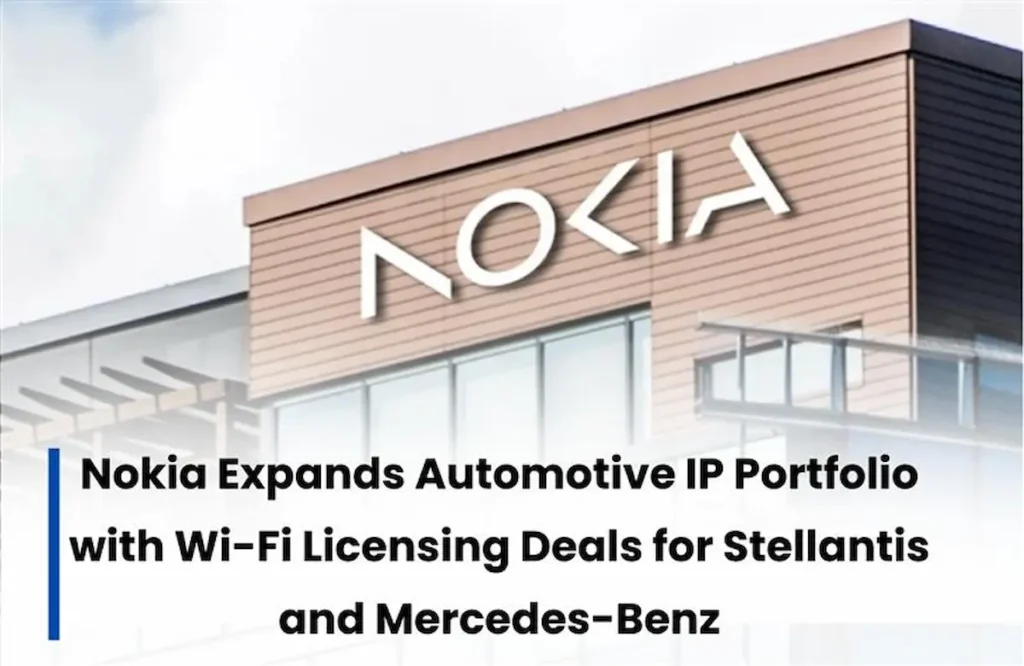
Vehicles are now effective mobile data centers rather than simply mechanical bias as a result of the machine industry’s significant digital shift. The demand for smooth, fast connectivity is at the center of this progress. Nokia officially revealed the Nokia and Mercedes Patent licensing Deal, signing of new Wi- Fi patent license agreements with two of the top automakers in the world, Stellantis and Mercedes-Benz, a major step that highlights the significance of intellectual property Rights in the period of smart buses. This advancement guarantees that the forthcoming generation of buses will continue to be connected and compatible with the law, marking a turning point in the relationship between telecommunications and transportation.
Enhancing the Base of Connected Vehicles via International Patent Licensing
Modern driving is increasingly defined by “infotainment” and over-the-air updates. To enable these functions, automakers must use Ficommon wireless technology. Nokia, a leader in networking standard exploration and development, owns a large number of Wi- Fi patents needed for these conditions. Stellantis and Mercedes-Benz attained the legal right to employ Nokia’s patented technologies in their vehicle lineups by entering into the Nokia and Mercedes Patent licensing Deal. This visionary approach to Patent Licensing avoids implicit legal issues and allows automakers to concentrate on invention, laying the root for unborn digital services.
How Nokia and Mercedes Patent Licensing Deal of Wi- Fi Patents Are Driving the Future of In-Auto Connectivity
When we think of Wi- Fi, we generally think of home routers, but the wireless stability conditions in a vehicle are mainly advanced. Nokia’s patent-defended results ameliorate the effectiveness and continuity of data transmission within the vehicle and between it and the external structure. Whether a Mercedes-Benz luxury hydrofoil downloads a necessary GPS update or a Stellantis SUV serves as a Wi- Fi hotspot for a family road trip, the underpinning technology is significantly reliant on these personal inventions. The licensing of these Wi- Fi patents ensures that the tackle installed into these vehicles matches global speed and security conditions, which is critical as buses become more independent.
A Fair and Balanced Approach to Intellectual Property in the Automotive Sector
Patent law may be a delicate field, especially when it comes to “Standard Essential Patents”( SEPs). Nokia has long supported for a fair, reasonable, and nondiscriminatory licensing approach( FRAND). Agreements with Mercedes- Benz and Stellantis demonstrate the efficacy of this common conception. By striking a respectable arrangement, these companies have shown that the telecoms and automotive diligence can unite to duly value intellectual property. This patent licensing mechanism allows formulators like Nokia to invest in future R&D, while manufacturers may be confident that their integrated wireless systems have been properly authorized.
Read Also: Patent Troll Litigation and How Companies Can Stay Protected
Why Mercedes-Benz and Stellantis are Prioritizing Intellectual Property Compliance
Patent law may be a delicate field, especially when it comes to “Standard Essential Patents”( SEPs). Nokia has long supported a fair, reasonable, and nondiscriminatory licensing approach( FRAND). Agreements with Mercedes-Benz and Stellantis demonstrate the efficacy of this common conception. By striking a respectable arrangement, these companies have shown that the telecoms and automotive diligence can unite to duly value intellectual property. This way of patent licensing allows formulators like Nokia to invest in future R&D, while manufacturers will be confident that their integrated wireless systems have been properly authorized and trusted.
The Ripple Effect: How The Nokia and Mercedes Patent Licensing Deal Impacts the Global Tech Landscape
Nokia’s recent triumph in the machine sector has the implicit ability to set the standard for other manufacturers who have yet to establish their intellectual licensing agreements. As the “Internet of Things”( IoT) expands into the garage, so will the demand for standardized Wi- Fi and 5G connectivity. Nokia’s capability to secure big deals with companies like Stellantis and Mercedes-Benz strengthens its position as a leading power in the patent licensing market. For the broader industry, this marks a change toward a more controlled and transparent terrain in which wireless standard formulators are fairly compensated, and technology devices may give outstanding interactive gestures for guests worldwide.
Recent Post
-
 Maxeon Solar and AIKO Solar Announce Strategic Patent Licensing Agreement for Strengthening Solar Innovation
 -
 First Solar and Oxford PV Sign US Patent Licensing Agreement
 -
 Formosa Pharmaceuticals and Arrotex Licensing Agreement for Clobetasol Ophthalmic Suspension
 -
 Why Patent Owners Struggle to Find the Right Buyers in Today’s Market
 -
 How Access to Global Patents Can Power the Startup India Movement