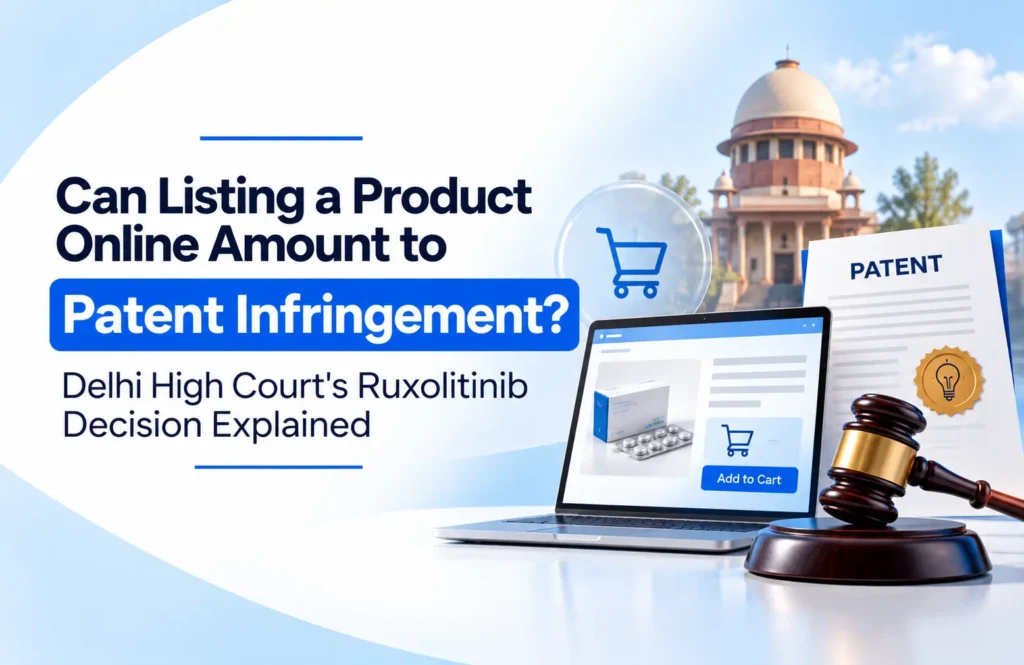
Can putting a patented product on an online platform amount to patent infringement?
The Delhi High Court recently faced this question in a ruxolitinib case. The dispute involved online ads and listings offering Ruxolitinib and Ruxolitinib Phosphate API for sale or supply.
The patent owner called this an “offer for sale” under Section 48 of the Patents Act, 1970. On September 24, 2026, the Court granted an ex parte ad interim injunction.
This does not make every online listing infringement as the patent claims, the product and the facts still matter. Below, we cover the facts, the order and the lessons.
Inside the Ruxolitinib Patent Dispute: The Facts
Incyte Holdings Corporation and the other plaintiffs went to the Delhi High Court, saying the defendants were advertising Ruxolitinib and Ruxolitinib Phosphate API for sale on an interactive commercial platform and accepting inquiries. The plaintiffs treated this as alleged patent infringement.
Their case rests on Indian Patent No. 269841 which covers the Ruxolitinib compound.
Granted in 2015, it is recorded in the court’s order as valid until December 12, 2026.
Scope and validity matter because a patent can only be infringed if it is in force and covers the product. No completed sale was involved, just online activity, which raises the question of whether it counts as an “offer for sale.”
Also Read:- 188 Patents, One Licensing Strategy: How Patent Portfolios Are Being Built for Commercialization?
Can an Online Product Listing Count as Patent Infringement?
Section 48 of the Patents Act, 1970, gives a patentee the exclusive right, subject to the Act, to stop others from making, using, offering for sale, selling or importing the patented product in India.
An “offer for sale” means presenting a product as available to buy or supply or inviting inquiries. A commercial online listing can fit this idea. Merely mentioning a product or technology for information is different.
In the Ruxolitinib case, the plaintiffs said the defendants advertised Ruxolitinib/Ruxolitinib Phosphate API, listed it on an online commercial platform, offered it for sale or supply and accepted business inquiries. They argued this was an offer for sale under Section 48.
The Delhi High Court’s Order
The Delhi High Court granted an ex parte ad interim injunction. “Ex parte” means the relief came before the defendants had fully presented their case. “Ad interim” means the relief is temporary and lasts during the case. The Court found the plaintiffs made out a prima facie case and weighed the balance of convenience and the risk of irreparable harm.
It restrained the defendants from manufacturing, stockpiling, importing, selling, offering for sale or supplying, exporting or otherwise dealing in products containing ruxolitinib, where that conduct amounts to infringement of the patent. This is not a final finding of infringement and it does not mean every online listing infringes a patent.
Does Every Online Listing of a Patented Product Amount to Infringement?
No. An online listing of a patented product isn’t always a problem. A website may simply mention or describe a patented product or technology without offering it commercially. That is general information.
A commercial listing is different. Here, a business presents the product as available for sale or supply or invites commercial inquiries.
This can raise a separate patent law question, because it may be an offer for sale. Even then, a listing alone does not decide infringement. Courts also weigh the patent claims, the product offered, what the business actually did, whether Section 48 covers it and the available evidence.
How the Ruxolitinib Case Affects Online Businesses?
The case highlights why websites, online marketplaces and supplier platforms can become relevant when a patented product is promoted or offered commercially. Businesses often advertise through company websites, online marketplaces, supplier platforms and digital product catalogs.
The order therefore provides an important example of how online commercial conduct can become relevant in a patent dispute. Still, it offers a useful lesson. A physical sale is not the only commercial activity. Here, the plaintiffs focused on advertising, listing and offering the product for sale or supply. This makes the timing and nature of online commercial activity relevant to a company’s broader patent risk assessment.
Online Activity Patent Owners Should Keep an Eye On
Patent owners can start by watching websites, online marketplaces and supplier platforms for uses that may conflict with their patents. If they spot a relevant listing, they may need to save the evidence.
This can include product descriptions, website or platform details, dates, statements about availability and commercial enquiry information. Such records can matter later if a patent dispute begins. Businesses have a part to play here too.
Before they advertise, offer or supply a product, they should review the patent landscape. The goal is quite simple: to understand whether planned commercial activity may fall within another party’s patent rights.
Takeaways for Businesses from the Ruxolitinib Order
A company’s website or marketplace listing is part of its commercial activity. When patented technology is involved, online promotion should not be treated as separate from patent issues. For pharmaceutical businesses, this means considering patent exposure as part of product launch and supply planning, rather than treating it as a separate legal issue.
This assessment can help companies identify potential restrictions before committing resources to a product, launch or supply arrangement. It can also guide when to launch, what to promote and how to plan supply. A little care early on can help businesses avoid costly legal disputes later.
The Case’s Impact on Patent Commercialization
Patent rights can shape how a technology or product is made, supplied, sold or commercialized. So businesses need to understand the IP position around a technology before they move ahead.
This is where Patent Monetize can help businesses and patent owners. Commercialization and patent strategy go together. Before licensing, assignment or any other deal, parties may need to review patent ownership, claim scope, validity and remaining term.
They should also look at the technology, market use and possible commercial applications.
The Ruxolitinib case reminds us that every decision turns on the particular patent and on the actual business circumstances involved.
Conclusion
The Delhi High Court’s order in Ruxolitinib makes an important point for businesses operating online, that commercial activity on a digital platform may become relevant to patent enforcement where there are allegations of the offer of sale or supply of a patented product.
The case raises the importance for companies to consider online product promotion as part of a broader picture of patent risk and commercialization planning.
Another way patent owners can track potentially relevant commercial activity is by monitoring digital channels. One useful way for patent owners to identify commercial activity that may be relevant to their rights is to monitor digital platforms.
Also Read:- Europe Moves to Strengthen IP Valuation: Why Patent Valuation Is Becoming a Strategic Priority
Recent Post
-
 Can Listing a Product Online Amount to Patent Infringement? Delhi High Court’s Ruxolitinib Decision Explained
-
 Europe Moves to Strengthen IP Valuation: Why Patent Valuation Is Becoming a Strategic Priority
-
 188 Patents, One Licensing Strategy: How Patent Portfolios Are Being Built for Commercialization?
-
 AWS’s $1 Billion + IP Licensing Deal: Why Companies License Technology Instead of Building Everything In-House
-
 Huawei Signs Multi-Year Patent License Deal with Qualcomm Covering AI & 5G, Expected to Push Licensing Value Past $6.9 Billion