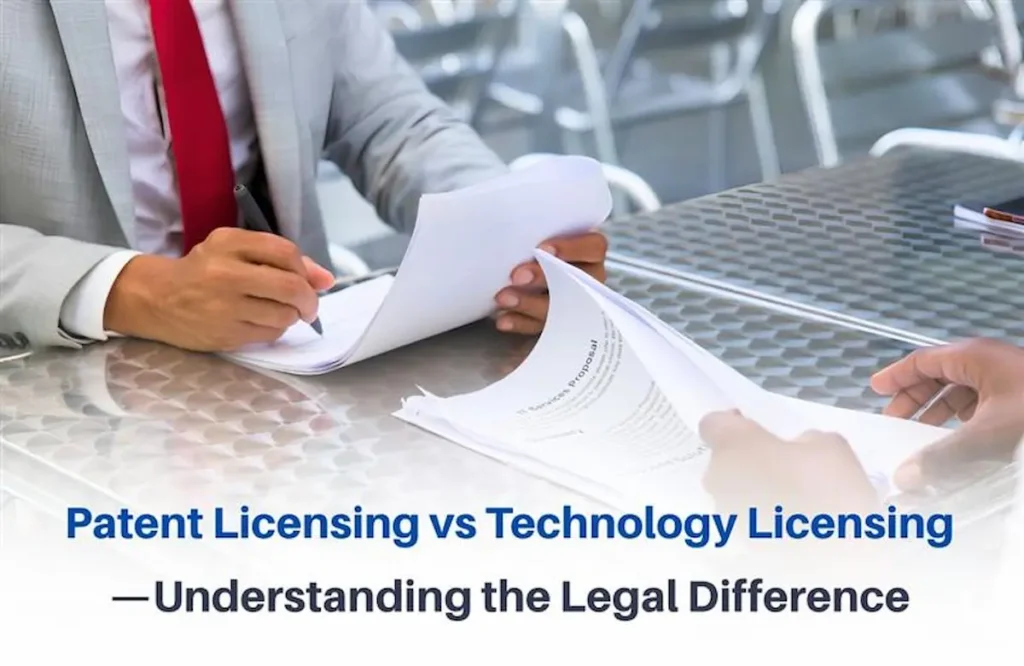
Companies often want to turn their technical inventions into profit. In the legal world of Intellectual Property (IP), you usually have two main paths: Patent Licensing or technology licensing. People often mix these up and get confused in Patent Licensing vs Technology Licensing comparison. But they aren’t the same. Each covers different assets and follows different rules. If you’re an inventor or a business owner, you need to know which one fits your goals. Let’s look at how they actually work.
Defining the Legal Scope of Patent Licensing Agreements
A patent license is a straightforward legal contract. The owner (licensor) gives someone else (licensee) the right to make, use, or sell a patented invention. It’s a specific grant of rights. The boundaries of this deal are set by the “claims” in the patent document. Because a patent is a negative right, the right to exclude others, a license is essentially a promise not to sue.
Think of a patent license as a legal shield. You are paying for the right to use an idea without getting hit with a Patent Infringement lawsuit. But there’s a catch. A patent license doesn’t usually come with a manual. The licensor gives you the legal “okay” to use the invention, but they don’t have to show you how to make it work in the real world. You get the legal permission, but the technical execution is entirely up to you.
Understanding the Broader Framework of Technology Licensing Contracts
Technology licensing is much bigger in scope than a simple patent grant. While a patent covers one specific invention, a technology license is a bundle of different rights. It often includes patents, but it also covers things like proprietary software, blueprints, and industrial designs. It is a commercial package rather than just a legal waiver.
When you sign a technology licensing agreement, you aren’t just buying a legal right. You are getting the actual tools needed to build a product or run a process. This is the main gap in Patent Licensing vs Technology Licensing. One is about legal permission; the other is about a total transfer of information. Because of this, these contracts are usually much more detailed. They cover how data is sent, who owns improvements to the tech, and how the licensee must protect the information they receive.
Read Also: Independent Inventors and Global Manufacturing Partners: Bridging the Gap with Patent Monetize
The Inclusion of Know-How and Trade Secrets in Licensing
Why does the distinction in Patent Licensing vs Technology Licensing matter so much for your bottom line? The answer is “know-how.” This refers to the secret methods, data sets, and practical skills that make a factory run smoothly. These details aren’t usually in a patent application because patents must be public. If a competitor can read your patent and still not figure out how to make the product efficiently, you have valuable know-how.
In a basic patent license, the licensor doesn’t have to teach you anything. They just step out of the way legally. But in a technology license, sharing trade secrets and know-how is the whole point. This is vital if you want to start production fast. Why spend years on trial and error when you can just license the proven method? Because of this, technology licenses often involve training sessions, technical support, and the delivery of thick binders full of specifications.
Analyzing the Duration and Maintenance of Legal Rights
The legal lifespan of these deals is also different. Patents eventually die. Usually, a patent lasts for 20 years from the day it was filed. Once that time is up, the invention is free for everyone to use. At that point, the patent licensing agreement effectively ends because there is no longer a legal right to enforce. You can’t charge someone to use something that belongs to the public.
Technology licensing is different. Trade secrets can last forever, as long as they stay secret. Think about the formula for a famous soda; it isn’t patented, it’s a secret. Even if the patent part of a deal expires, you might still have to pay royalties for the secret methods or software code included in the contract. This makes the legal relationship much more durable. It also means the licensee must be much more careful about confidentiality, even decades after the deal starts.
Read Also: Patent Licensing Is Transforming the Way Automobile & EV Manufacturers Build New Products
The Financial Structure of Intellectual Property Royalty Payments
When we talk about Patent Licensing vs Technology Licensing, we also have to talk about the money. In a patent license, the royalty is usually tied directly to the sale of products that fall under the patent claims. If the patent is found invalid in court, the royalty payments usually stop immediately. The legal basis for the payment has disappeared.
In a technology license, the payment structure is often more complex. You might pay an upfront fee for the “tech transfer” and then ongoing royalties for the use of the brand or the secret process. Because the license covers more than just a patent, the licensee often finds it harder to get out of paying. Even if a court strikes down the patent, the licensee might still owe money for the software or the expert training they received. This provides the licensor with a more stable and diverse stream of income.
Choosing Between Technology Licensing and Patent Licensing for Your Business
So, which one do you need? It depends on what you are trying to buy or sell. If you already have a world-class engineering team and just need to avoid a lawsuit, get a patent license. This gives you “freedom to operate.” It’s a clean, legal transaction that clears the path for your own development.
But if you are entering a new industry and need the full blueprint, the source code, and expert training, you need a technology license. It’s a deeper partnership that involves more trust and more moving parts. Getting the choice right in Patent Licensing vs Technology Licensing keeps you out of court and ensures you aren’t paying for things you don’t need. When the legal language is clear, you can focus on growing your business instead of arguing over what “technology” actually means in a contract. Using the right legal tool ensures that both the inventor’s hard work and the manufacturer’s investment are safe.
Recent Post
-
 188 Patents, One Licensing Strategy: How Patent Portfolios Are Being Built for Commercialization?
 -
 AWS’s $1 Billion + IP Licensing Deal: Why Companies License Technology Instead of Building Everything In-House
 -
 Huawei Signs Multi-Year Patent License Deal with Qualcomm Covering AI & 5G, Expected to Push Licensing Value Past $6.9 Billion
 -
 Hassle-Free Closures: How Patent Monetize Manages Everything from Listing to Legal Closure
 -
 Types of Patent Licensing: Exclusive, Non-Exclusive, and Sole Licenses Explained