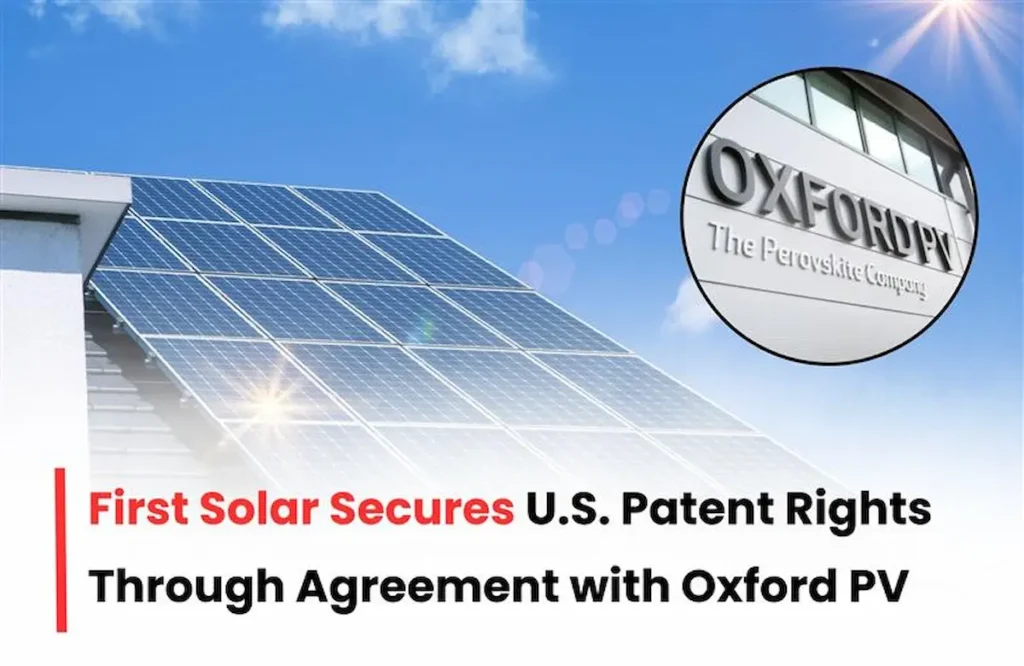
The solar energy sector is currently witnessing a significant shift in its technological landscape, driven by the need for higher efficiency and robust intellectual property frameworks. Recently, industry leaders First Solar and Oxford PV announced a definitive agreement that underscores the growing importance of legal cooperation in renewable energy. This development, centered around the First Solar and Oxford PV Patent Licensing Agreement, marks a pivotal moment for the commercialization of next-generation solar technologies in the United States.
Strengthening Infrastructure through Patent Licensing
At its core, this partnership is designed to facilitate the integration of advanced perovskite technology into the broader solar market. Oxford PV, a pioneer in perovskite-on-silicon tandem cells, has spent years developing a portfolio that pushes the boundaries of traditional photovoltaic efficiency. By entering into this First Solar Oxford PV patent licensing agreement, First Solar gains the legal authorization to utilize specific proprietary technologies that are essential for high-performance solar modules.
The process of Patent Licensing is more than just a business transaction; it is a strategic legal maneuver that allows companies to share innovation while maintaining strict control over their intellectual assets. For First Solar, this agreement provides a clear runway to enhance its thin-film technology without the risk of IP litigation. For Oxford PV, it serves as a validation of its research and development efforts, ensuring that its inventions are deployed at scale through a trusted industry partner.
The Role of Patent Protection in Solar Innovation
One of the primary drivers behind this agreement is the necessity of rigorous Patent Protection. In the highly competitive semiconductor and solar industries, protecting a technical “moat” is vital for long-term survival. The agreement ensures that the specific chemical compositions and manufacturing processes developed by Oxford PV remain legally shielded from unauthorized use by third parties.
When companies engage in such high-level agreements, they are essentially creating a closed ecosystem where innovation is incentivized. Without strong Patent Protection, the massive capital investment required to develop perovskite technology would be too risky for most firms. This licensing deal provides a structured legal environment where both parties can operate with certainty, knowing that their contributions to the field are recognized and protected under U.S. patent law.
Determining Value: Patent Valuation in the Energy Sector
A critical aspect of the negotiations between First Solar and Oxford PV likely involved the complex process of Patent Valuation. Before a licensing fee or royalty structure can be established, legal and financial experts must determine the economic worth of the intellectual property involved.
In the context of the First Solar and Oxford PV Patent Licensing Agreement, Patent Valuation takes into account the potential market share, the projected increase in module efficiency, and the remaining lifespan of the patents. By accurately assessing the value of Oxford PV’s portfolio, First Solar can justify the investment to its stakeholders, while Oxford PV ensures it receives fair compensation for its scientific breakthroughs. This professional assessment of worth is what allows the global renewable energy market to remain stable and predictable.
Read Also: Why Patent Owners Struggle to Find the Right Buyers in Today’s Market
Implications for the US Solar Market
The collaboration between these two entities is expected to have a ripple effect across the American solar supply chain. As First Solar integrates these licensed technologies, the industry can expect to see a new generation of solar panels that outperform current standards. This is particularly important as the United States seeks to bolster its domestic manufacturing capabilities and reduce reliance on external energy sources.
The First Solar Oxford PV Patent Licensing agreement serves as a blueprint for how thin-film and tandem cell technologies can coexist and complement one another. By leveraging the strengths of both companies, the agreement accelerates the timeline for bringing advanced solar solutions to utility-scale projects across the country.
Conclusion
The signing of the First Solar and Oxford PV Patent Licensing Agreement represents a sophisticated intersection of engineering and intellectual property law. Through the strategic use of Patent Licensing, both companies have secured a path forward that emphasizes collaboration over competition.
This partnership highlights how essential Patent Protection is for fostering innovation, and how detailed Patent Valuation remains the cornerstone of successful corporate deal-making. As the solar industry continues to evolve, such agreements will remain vital in ensuring that the transition to clean energy is built on a foundation of legal integrity and technological excellence. This clean and structured approach to intellectual property will undoubtedly benefit the industry and the environment for years to come.
Recent Post
-
 188 Patents, One Licensing Strategy: How Patent Portfolios Are Being Built for Commercialization?
 -
 AWS’s $1 Billion + IP Licensing Deal: Why Companies License Technology Instead of Building Everything In-House
 -
 Huawei Signs Multi-Year Patent License Deal with Qualcomm Covering AI & 5G, Expected to Push Licensing Value Past $6.9 Billion
 -
 Hassle-Free Closures: How Patent Monetize Manages Everything from Listing to Legal Closure
 -
 Types of Patent Licensing: Exclusive, Non-Exclusive, and Sole Licenses Explained