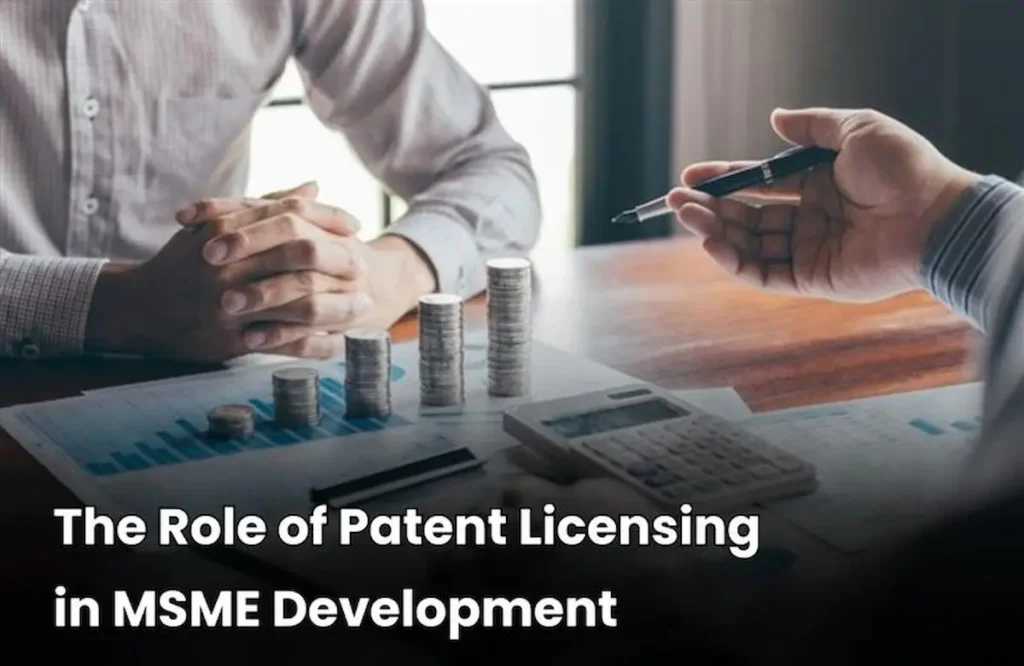
In the current industrial landscape, Intellectual Property Rights (IPR) serve as essential business assets. For Micro, Small, and Medium Enterprises (MSMEs), the strategic management of these assets is a primary driver of commercial success. Patent licensing in MSME operations allows a smaller entity to leverage its technical innovations without requiring the massive capital typically needed for large-scale manufacturing.
The Legal Framework of Patent Licensing
Patent licensing is a legal contract. In this agreement, the owner of a patent (the licensor) permits another company (the licensee) to use, make, or sell the invention. In return, the licensee pays a fee or a percentage of sales to the owner.
For a small business, Patent Licensing functions through two main commercial methods:
- Commercialization through Licensing: The MSME grants rights to a partner to use its technology. This allows the MSME to earn revenue through royalties while the partner handles the costs of production and market distribution.
- Technology Acquisition: The MSME obtains rights to a patent owned by another entity. This helps the small business upgrade its own products or enter a new market segment quickly without high research costs.
By incorporating patent licensing into MSME strategies, small businesses can scale their operations more efficiently.
Read Also: Connecting Innovation with Industry for Large-Scale Growth through Patent Monetization
Revenue Generation through Patent Monetization
The process of extracting financial value from intellectual property is known as patent monetization. For many MSMEs, a patent is a “non-performing asset” until it is actively commercialized. Through patent monetization, a business can create new streams of income that are not dependent on physical sales.
Effective patent monetization involves several legal and financial components:
- Royalty Payments: The licensee pays a percentage of their revenue to the MSME.
- Upfront Fees: A fixed amount paid at the start of the licensing agreement to provide immediate liquidity.
- Cross-Licensing: Two companies exchange patent rights, which prevents legal disputes and allows both to innovate more freely.
Market Expansion and Patent Licensing in MSME
A significant benefit of patent licensing is the ability to expand into geographic areas where the MSME does not have a physical presence. By licensing their technology to international partners, small businesses can earn global profits without the risks associated with setting up foreign branches.
Furthermore, patent licensing in MSME development increases the company’s Patent Valuation. Financial institutions and investors view a licensed patent as proof of a viable product. This legal standing makes it easier for MSMEs to secure loans, government grants, and venture capital. When a patent is active in the market through patent monetization, it serves as a credible indicator of the firm’s technical and commercial strength.
Conclusion: Strengthening the Small Business Sector
The integration of Intellectual Property Rights into the business model is a requirement for long-term sustainability. Through patent licensing and a focused approach to patent monetization, MSMEs can overcome the limitations of their size. These legal tools provide a structured pathway for small innovators to gain a share of the global market.
By prioritizing patent licensing in MSME strategies, the sector can move from simple manufacturing toward becoming a high-value, technology-driven industry.
Recent Post
-
 188 Patents, One Licensing Strategy: How Patent Portfolios Are Being Built for Commercialization?
 -
 AWS’s $1 Billion + IP Licensing Deal: Why Companies License Technology Instead of Building Everything In-House
 -
 Huawei Signs Multi-Year Patent License Deal with Qualcomm Covering AI & 5G, Expected to Push Licensing Value Past $6.9 Billion
 -
 Hassle-Free Closures: How Patent Monetize Manages Everything from Listing to Legal Closure
 -
 Types of Patent Licensing: Exclusive, Non-Exclusive, and Sole Licenses Explained