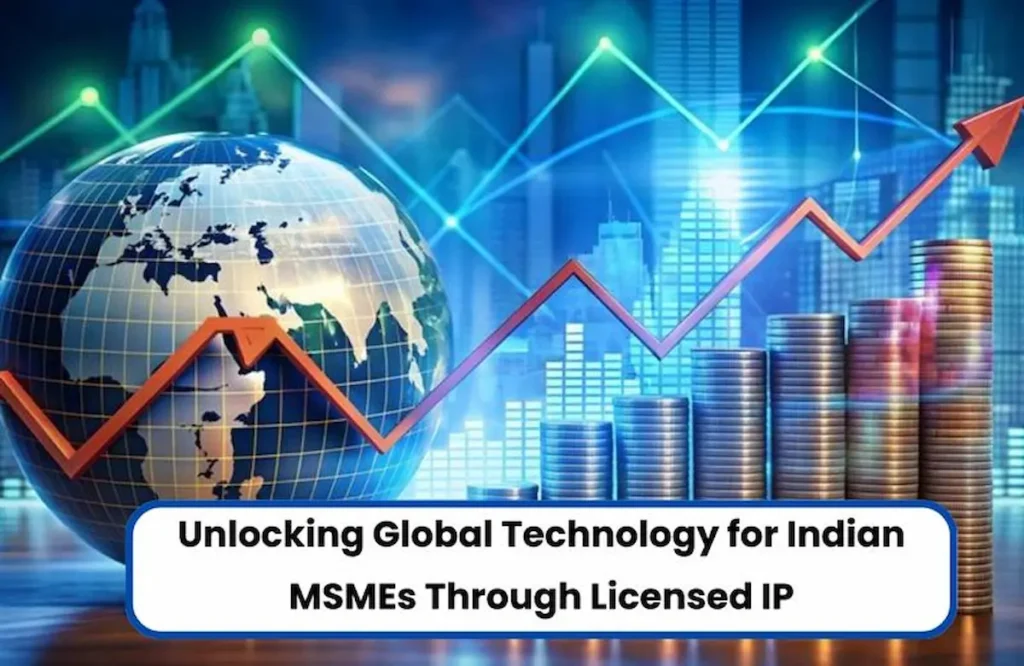
The Micro, Small, and Medium Enterprises (MSME) sector serves as the backbone of the Indian economy, contributing significantly to industrial output and employment. However, a persistent challenge remains: the “technological gap” between domestic manufacturing capabilities and global innovation standards. To bridge this divide, Indian enterprises must shift from traditional acquisition models toward strategic patent commercialization and Patent Licensing for MSMEs. By leveraging international intellectual property (IP), small businesses can integrate advanced technical solutions without the prohibitive costs of primary research and development.
The Strategic Role of Patent Licensing for MSMEs
For an MSME, the acquisition of technology is often governed by the legal framework of patent licensing. This is a contractual arrangement where the proprietor of a patent (the licensor) grants permission to another entity (the licensee) to manufacture, use, or sell the patented invention for a specific period within a defined territory.
Under the Patents Act, 1970, licensing serves as a primary vehicle for technology transfer. Unlike outright assignments, where the title of the patent is transferred permanently, licensing allows MSMEs to access high-tier global technology through royalty-based models. This ensures that capital-strapped enterprises can deploy “state-of-the-art” machinery or processes by paying a fraction of the technology’s total valuation as periodic fees.
Read Also: Foreign Patents and Their Significance for India’s Manufacturing Growth through Patent Monetization
Enhancing Competitiveness via Patent Commercialization
Patent commercialization is the process of extracting economic value from a protected invention by bringing it to the marketplace. For Indian MSMEs, this often involves “In-licensing”, acquiring rights to foreign technologies to improve domestic production efficiency.
The legal benefits of this approach are threefold:
- Risk Mitigation: By licensing proven global technologies, MSMEs bypass the financial instability and technical uncertainties inherent in the multi-year development cycle of unproven experimental technologies.
- Market Exclusivity: An exclusive license can grant an MSME a localized monopoly, preventing competitors from utilizing the same technology within the Indian market.
- Standard Compliance: Global patents often align with international quality standards, enabling MSMEs to enter export markets with greater ease.
Mechanisms of Patent Monetization for MSMEs
While many view patents solely as defensive tools, patent monetization transforms intellectual property into a liquid business asset. MSMEs that develop their own incremental innovations can engage in “out-licensing” to generate non-operational revenue.
In the context of global accessibility, monetization also refers to the structured financial IP Valuation. Indian MSMEs can use their licensed or owned patent portfolios as collateral for raising capital. Legal instruments such as “Security Interests” in patents allow firms to secure institutional funding, which can then be reinvested into further technology absorption.
Overcoming Barriers for MSMEs through Technology Transfer
Despite the clear advantages, the transition to an IP-led growth model faces hurdles. Many MSMEs struggle with “informational asymmetry”, the inability to identify which global patents are available for licensing or which are approaching their expiration (entering the public domain).
Furthermore, the complexity of negotiating “FRAND” (Fair, Reasonable, and Non-Discriminatory) terms requires specialized techno-legal expertise. To make global technology truly accessible, the focus must remain on:
- Prior Art Searching: Identifying global patents that can be legally bypassed or licensed.
- Freedom to Operate (FTO) Analysis: Ensuring that the adoption of a new technology does not infringe upon existing third-party rights within India.
- Valuation Reports: Accurately determining the market value of a license to ensure fair royalty outflows.
Conclusion
The integration of Indian MSMEs into the global value chain is contingent upon their ability to navigate the complexities of Intellectual Property Rights (IPR). By focusing on patent commercialization and strategic patent licensing, these companies can sidestep decades of R&D cycles. By treating IP as a core business asset rather than a legal formality, MSMEs can ensure that “Made in India” is synonymous with world-class innovation.
Effective patent monetization and licensing strategies do more than just protect ideas; they provide the legal and financial infrastructure necessary for Indian small businesses to compete on a global scale.
Recent Post
-
 Hassle-Free Closures: How Patent Monetize Manages Everything from Listing to Legal Closure
 -
 Types of Patent Licensing: Exclusive, Non-Exclusive, and Sole Licenses Explained
 -
 How Patent Monetize Helps International Tech Owners Capture Massive Consumer Bases
 -
 Fighting SEP Abuse: Why Lenovo Partnered with Save Our Standards Coalition in 2026
 -
 Asus and Nokia End Video Coding Litigation with Global Patent Licensing Deal