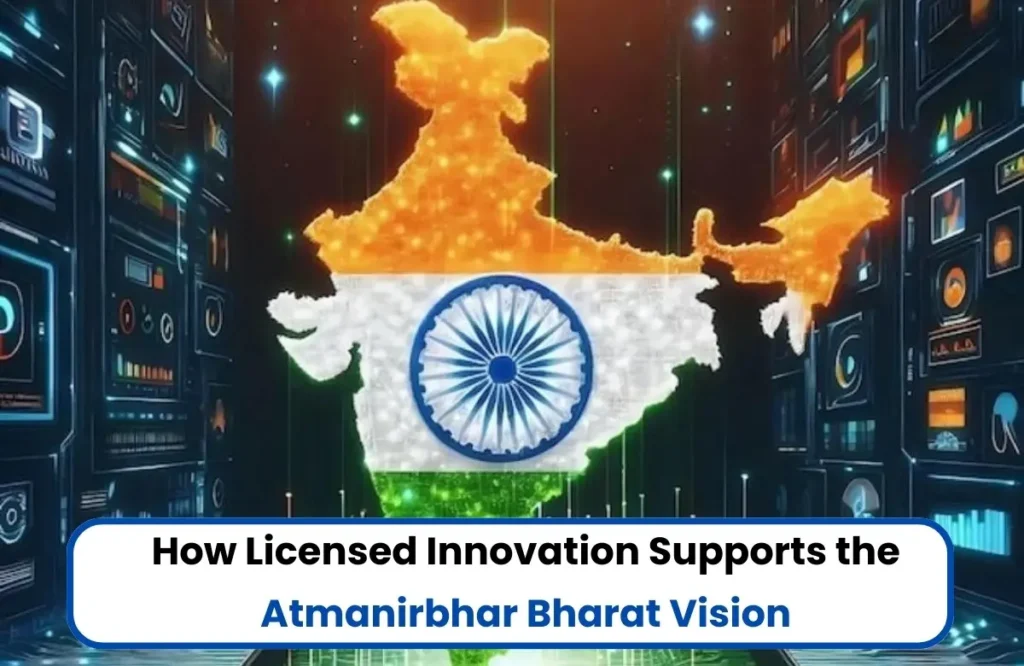
The vision of Licensed innovation Aatmanirbhar Bharat, or a self-reliant India, represents a fundamental shift in the nation’s economic identity. It is a movement to transition from being a primary consumer of global technology to becoming a leading creator of it. While manufacturing remains a vital pillar of this initiative, the long-term sustainability of a self-reliant economy depends on the strength of Intellectual Property Rights (IPR). To move towards a trillion-dollar digital economy, India must prioritize the strategic use of Licensed Innovation Aatmanirbhar Bharat.
Licensed Innovation: The Bridge to Industrial Growth
Self-reliance does not imply a closed economy; rather, it suggests a robust internal system where indigenous ideas are legally protected and scaled through commercial partnerships. The most efficient bridge between a laboratory invention and a market-ready product is Patent Licensing. This legal mechanism allows inventors to grant manufacturing rights to businesses under specific terms. Through Patent Licensing, India can accelerate industrial growth by allowing companies to adopt sophisticated, locally-owned technologies rather than relying on imports.
Bridging the Research-Market Gap Through Patent Monetization
For many years, there was a significant gap in India between academic research and commercial success. Many brilliant inventors secured patents, but those assets often remained underutilized. The modern framework of Licensed innovation Aatmanirbhar Bharat seeks to bridge this gap by encouraging Patent Monetization. This is the professional process of turning a legal intellectual asset into a consistent revenue stream. When a startup or research institution engages in Patent Monetization, it generates the necessary capital to fund future research. This creates a self-sustaining cycle of innovation that strengthens the national economy.
The legal structure of IPR provides the essential security required for this ecosystem to function. When an Indian enterprise enters into a Patent Licensing agreement, it is acquiring the right to use a solution that has already been vetted and legally protected. This significantly reduces the research and development risk for Micro, Small, and Medium Enterprises (MSMEs). It allows them to enhance their production quality and compete globally while ensuring that the original Indian inventor receives fair financial compensation for their intellectual labor.
Strengthening National Resilience and Internal Tech Transfer
Furthermore, Patent Licensing serves as a vital tool for technology transfer within our borders. In sectors like healthcare, defense, and infrastructure, the need for specialized equipment is high. By fostering a culture where local patents are licensed to multiple domestic manufacturers, the country ensures that essential goods are produced locally at a competitive cost. This democratization of technology is a key component of national resilience and supply chain security.
However, for this Licensed innovation Aatmanirbhar Bharat model to be truly effective, the Indian industry must view intellectual property as a strategic business asset. Effective Patent Monetization is more than just a legal transaction; it is about identifying the right industrial partners who can apply a technology to solve real-world problems. This requires professional valuation, clear legal due diligence, and an understanding of market demands. As Indian entities become more proficient in Patent Monetization, they contribute to the national GDP by exporting Indian intellectual expertise to the global market.
Read Also: Sony Signs Patent License Renewal Agreement with InterDigital
Policy Frameworks and the Future of Licensed Innovation
Government initiatives, such as those led by NITI Aayog and the Atal Innovation Mission, have been instrumental in raising awareness about these legal pathways. By simplifying the Patent filing process and providing incentives for innovation, the state is laying the groundwork for a future where Patent Licensing is a standard corporate practice. As more businesses understand the protections offered by the Indian Patent Act, the appetite for collaborative innovation continues to grow.
In conclusion, supporting Licensed innovation Aatmanirbhar Bharat is a sophisticated and necessary strategy for modern India. It transforms self-reliance from a policy goal into a tangible economic reality. Through the diligent application of Patent Licensing, we ensure that Indian inventions reach the public. Simultaneously, by focusing on Patent Monetization, we empower our inventors and entrepreneurs to remain financially viable and globally competitive. By respecting the legal framework of IPR, India is building an economy that is not only independent but is also a global hub for the technologies of tomorrow.
Recent Post
-
 HPE Joins Sisvel Wi-Fi Multimode Pool: Strengthening Wi-Fi 7 Patent Strategy
 -
 Empowering Indian MSMEs: How Patent Monetize Unlocks Global IP for Local Production
 -
 How Patent Monetize is Tech-Powering Indian MSMEs for the 2026 Electronics Surge
 -
 China Steps Up Patent Commercialization to Drive Innovation Growth
 -
 Patent Royalties Explained: How Much is Your Invention Really Worth?